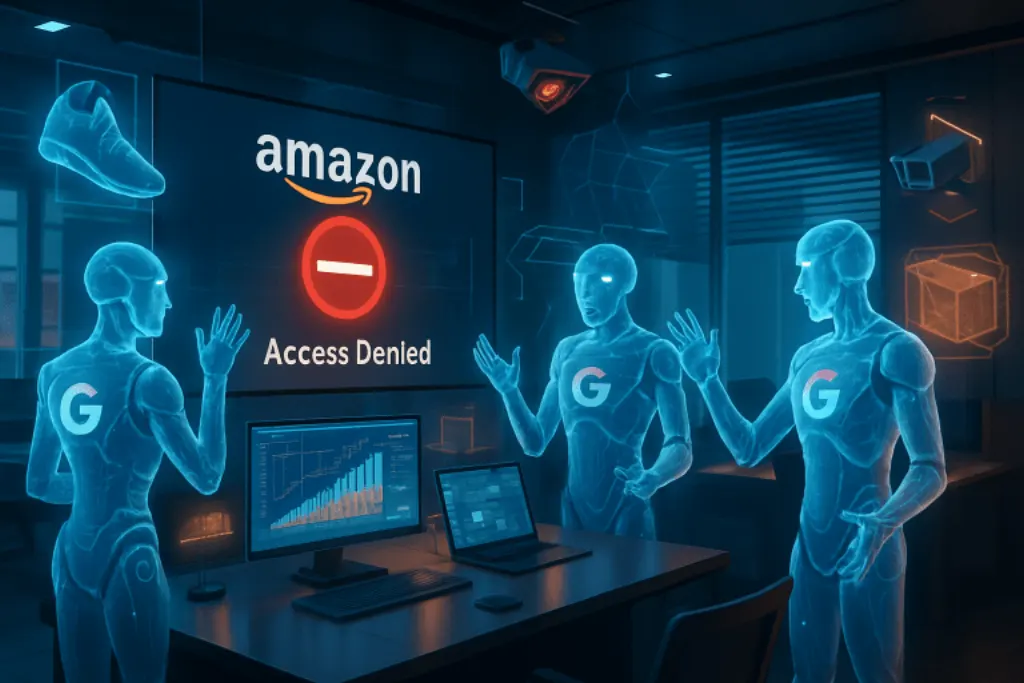
Amazon bans Google’s AI shopping agents from its e-commerce platform
Contents7
Amazon recently took decisive steps to restrict access to its e-commerce platform by AI shopping agents developed by Google. This decision demonstrates Amazon’s desire to maintain strict control over the interaction of these advanced technologies with its own systems, a move that comes amidst a competitive landscape marked by the ubiquity of AI technologies. As the world of e-commerce undergoes rapid transformation with the emergence of agents capable of browsing the web, recommending products, and automatically completing purchases, Amazon is choosing a precautionary approach to protecting its digital assets. In contrast to the more open stance of its competitors, such as Shopify and Walmart, Amazon seeks to maintain its market dominance while protecting its advertising revenue and data.
Amazon and the Strict Management of AI Shopping Agents
Amazon recently modified its robots.txt files to block new AI shopping agents from Google and other companies such as OpenAI and Anthropic. The robots.txt file is a document used by websites to indicate which parts of a site should not be accessed by robots or AI agents. This strategic decision comes at a time when AI shopping agents are becoming increasingly common, capable of radically transforming the way consumers interact with e-commerce platforms.
A key factor in this decision lies in the protection of Amazon’s product information and pricing strategies. By preventing access to its platform, Amazon is protecting not only its business model, but also its valuable, high-revenue advertising division. Indeed, with an estimated $56 billion in advertising revenue, Amazon must maintain absolute control over how its data is used and its partners. source
This measure, moreover, is justified by the need to limit the exploitation of Amazon’s data by its direct competitors. The data collected by AI agents can indeed be used to gain significant competitive advantages in the e-commerce market, whether to refine learning algorithms, improve ad targeting, or dynamically adjust prices.

Find out why Amazon has decided to prohibit Google’s artificial intelligence shopping agents from accessing its e-commerce platform. This decision could have significant implications for digital commerce and competition in the sector. On the other hand, other players in the sector, such as Walmart, are becoming more open to the potential of AI agents. By developing their own artificial intelligence tools and encouraging partnerships, they are choosing a more cooperative and adaptive approach to AI, while hoping to increase their share of online sales, which still represents only a fraction of their total revenue.
Indeed, Walmart recently introduced Sparky, a chatbot that could eventually allow customers to place orders and manage recurring orders such as weekly grocery shopping. source.
Why is this decision crucial for Amazon?
Amazon’s decision to restrict access to AI shopping agents stems from several strategic considerations. First, by limiting competitors’ ability to scan its product pages, Amazon ensures it maintains its dominant position by minimizing opportunities for rivals to copy or supplant its business strategy. This includes, in particular, the fine details of product descriptions, promotional offers, and even customer reviews, which constitute a valuable asset for the retail giant.
Second, Amazon pursues a dual objective: to protect its immense data pool and increase the security of its advertising activities against excessive exploitation by third-party technologies. By maintaining strict control over these aspects, Amazon can continue to develop its user experience and personalized offers, while taking advantage of technological advances internally.
E-commerce in the era of AI shopping agents
The rise of AI shopping agents is generating growing interest in the world of e-commerce. These technologies, which have become essential, are characterized by their ability to conduct searches, offer personalized recommendations, and finalize purchases autonomously for users. The potential of these technologies is immense, both in terms of personalizing offers and automating purchasing processes.
For example, AI-powered shopping agents are able to analyze thousands of online product options, filter results based on user preferences, and even find the best available deals. This automation responds to a growing need for convenience among consumers, who are looking to simplify and improve their digital shopping experience. Such a breakthrough could represent a kind of revolution in the e-commerce sector. source
However, the widespread implementation of AI-powered shopping agents also raises important business and ethical questions. Platforms must balance the benefits of these technologies with the protection of their sensitive data. This is the context in which Amazon’s approach fits, placing security and control at the center of its concerns.
A notable nuance is that this is not the case for all competitors. Shopify, for example, prefers to engage in strategic partnerships while requiring that artificial purchasing processes be validated by human intervention via their interface. Shopify secures its transactions while benefiting from technological innovation.

Videos, Table, and Impact of Buying Agents
In this constantly evolving environment, it is essential to assess the concrete impacts of using AI buying agents in e-commerce. Here is a table summarizing these impacts:
Amazon and Platform Security in the Digital Age
Ensuring the security of its digital platform has become a major strategic issue for Amazon in the current context of cyber threats and the rapid evolution of AI technologies. This security dimension is even more crucial when considering the growing influence of AI shopping agents on the market. These agents, while innovative, pose new challenges in managing and protecting the sensitive data of millions of users. Amazon has chosen to erect digital walls to ensure that its competitors’ AI agents do not have free and unrestricted access to its vast platform. This decision raises interesting questions about competition management in the digital sector, where the sharing of information and technology must be balanced with a concern for protection and security.
source https://digest.allm.link/fr/blogs/amazon-ai-to-buy-products-from-other-sites/At the same time, Amazon continues to invest in its own AI solutions to enrich the user experience, notably with the development of
Nova Act **, a new AI agent that promises to revolutionize the way users interact with the platform. Nova Act is designed to intelligently navigate and interact with online content, while respecting the same high security standards that Amazon has committed to maintaining.**source https://technplay.com/ia-amazon-decouvrez-nova-act-agent-qui-va-revolutionner-la-plateforme/The table below summarizes the main security strategies implemented by Amazon to protect its platform against the rise of AI agents:
Safety measure
Effective security on e-commerce platforms is not simply limited to filtering access, but also encompasses proactive initiatives to anticipate and manage possible threats. Indeed, with the growing popularity of AI purchasing agents, consumer protection and the security of their data are becoming strategic imperatives to avoid the harmful consequences of malicious or unauthorized exploitation.
Amazon’s efforts perfectly illustrate this trend, showing that rigorous monitoring and investment in in-house AI solutions is not only beneficial, but necessary to remain competitive. This pragmatic approach will likely help Amazon maintain its leadership in the e-commerce market while ensuring the security and satisfaction of its users.
As Amazon ensures its security against AI purchasing agents, the e-commerce landscape continues to transform under the constant influence of advances in AI technology. The opportunities inherent in this rapid adoption of artificial intelligence are vast, but they also come with challenges in integrating and ethically using these technologies.
The development of powerful AI purchasing agents not only impacts the internal management of companies like Amazon, but also impacts overall competition. This technological advancement offers consumers a more convenient and efficient way to navigate the countless online purchasing options, while raising legitimate questions about regulation and access policies for new commercial data.
In this graph, we observe how some of the biggest names in the industry, such as Amazon, Google, and Alibaba, are aligning their strategies around AI innovations:
Company
Learn how Amazon recently blocked Google’s AI-powered shopping agents from accessing its e-commerce platform, revealing growing tensions between the two tech giants. We analyze the implications for the e-commerce sector.

Read next
 E-commerce news
Google is strengthening its bet on AI-assisted commerce with a new platform for intelligent shopping agents.
According to the National Retail Federation’s flagship event in 2026, Google unveiled its new flagship in the field of A
 E-commerce news
At TikTok’s first major e-commerce summit, the platform ramped up its commitment to live shopping while sharing key learnings from China.
At TikTok's first major e-commerce summit, the platform showcased a promising future for live shopping, drawing inspirat
 E-commerce news
AI agents power e-commerce startup, founded by Google and DeepMind alumni, which raises $10 million in seed funding
Technological progress has transformed the way we consume, and Artificial Intelligence (AI) plays a central role in this
 E-commerce news
Google is testing a new map dedicated to shopping at the top of search results
Google continues to revolutionize the online shopping experience by introducing a card dedicated to shopping at the top