Google’s Ad Intelligence: AI Features and Tips to Optimize Your Ads in 2025
Contents5
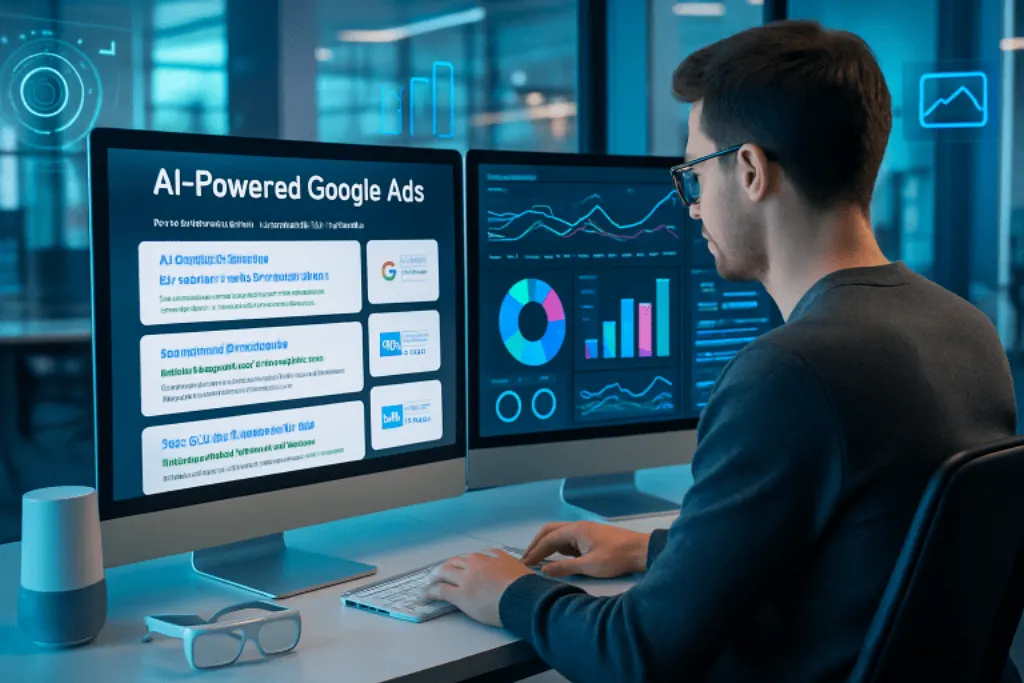
As we enter 2025, technological advancements continue to transform the digital advertising landscape. At the center of this revolution, Google Ads stands out with its advanced artificial intelligence capabilities that promise to optimize every aspect of advertising campaigns. AI features continue to push the boundaries of what’s possible, thanks to innovations such as automated image editing, optimized targeting, and smart bidding. For businesses of all stripes, understanding and leveraging these tools is becoming essential to getting the most out of their advertising investments.
Advanced AI Features in Google Ads
In 2025, the artificial intelligence built into Google Ads will prove fundamental to building effective advertising campaigns. From smart bidding to image generation, these tools are radically transforming ad creation and management. It all started with Smart Bidding, a strategy that, since 2016, has automatically adjusted bids to maximize conversions based on user-defined goals. Using machine learning, Google analyzes contextual signals, such as the user’s device or past search behavior, to determine the likelihood of conversion and adjust bids in real time. For example, a shoe retailer might have its bids automatically increased for searches such as « buy size 9 leather boots, » increasing the likelihood of conversion. In parallel, the Broad Match option allows your ads to appear for relevant searches, even if the specific terms aren’t in your keyword list. This works best when combined with Smart Bidding, ensuring aggressive bidding only on terms likely to convert. For example, a furniture business might use broad match for the word « sofa, » reaching customers searching for related terms like « sofa for small apartment. »
One major recent addition is the conversational experience, which turns campaign creation into a dialogue with Google’s AI, facilitating ad generation without getting into technical details. Imagine a yoga supply store owner simply saying, « I want to promote yoga mats, » and instantly receiving relevant suggestions. Feature DescriptionBenefit
Smart Bidding Auction Automation Real-Time Conversion Optimization
Broad Match Broad Keyword MatchingAd Reach Extension

Technology
Form of optimization Potential impact Responsive Search Ads
Multiple combinations of headlines and descriptions Improved conversion rateOptimized targeting
Increased reach and new conversions
In 2025, Google will also integrate AI-generated images into its ads, allowing brands to quickly create high-quality visuals without a dedicated photographer, as demonstrated in an article by Alanna & Company on the impact of AI . You submit a simple descriptive text, and let AI compose captivating scenes that will enrich your visual campaign.
Discover how to leverage Google’s advertising intelligence: explore new AI-powered features and our tips for optimizing your ads and boosting your marketing performance in 2025. Image Revolution and New Advertising Era
The power of visuals is something Google Ads perfectly captures. In an era where consumers are drawn to aesthetics as much as content, AI-generated images are becoming undeniable assets. These images are designed to not only illustrate but also reinforce the ad’s message.
Proactivation: Implementing contextual barriers (such as keyword exclusion lists) to guide AI in its decisions becomes essential for effective targeting. Adaptability: Stay alert to market trends and be ready to adjust your campaigns based on changes in consumer behavior.Through these measures, businesses ensure they stay ahead in an increasingly competitive world. Both small and large enterprises benefit from these approaches, and the autonomy offered by AI eases significant human resource constraints. For example, a report from

depicts how marketing automation is implemented to optimize each customer engagement, revealing increased efficiency and impressive ROI. The Dynamics of AI in Today’s Market
With the growing dominance of e-commerce giants like Amazon and Alibaba, as demonstrated by
Alanna & Company
Google Ads, alongside platforms like Meta Ads and The Trade Desk, uses AI to anticipate user needs and display ads that appear to anticipate their wants. For example, a user who recently visited pages related to gadgets could see ads targeted to the latest tech devices, regardless of whether they’re on sites like Taboola or Adobe Advertising Cloud.
By leveraging this ecosystem, brands are adapting their advertising to meet growing expectations for personalization and authentic engagement. The combination of AI and emotional relevance in messaging is undoubtedly key for 2025.
As advertising tools continue to evolve, keep an eye on future AI developments, as seen by Google Ads’ backer With constant innovations, the future promises even more intuitive and effective campaigns.
/decouvrez-les-incroyables-avancees-de-shopify-en-2024-qui-vont-vous-epoustoufler/
Read next
 Shopify
SEO Product Descriptions: 7 Essential Tips to Optimize Your Product Pages in 2024
IN BRIEF Develop SEO product descriptions helps improve visibility on search engines like Google. Use relevant keywords
 Shopify
Black Friday and e-commerce: 20 tips and strategies to boost your end-of-year sales in 2025
Black Friday, which has become an essential annual tradition for consumers and retailers, presents a golden opportunity
 Shopify
Google and Shopify are the top winners of 2025: as new strategic points of sale approach
The Rise of Google and Shopify in 2025 By 2025, the dynamics of the online retail market are transforming at breakneck s
 Shopify
Order tracking on Shopify: optimize your management and improve the customer experience
Shopify is an e-commerce platform that allows entrepreneurs to create their own online store, with a large number of fea