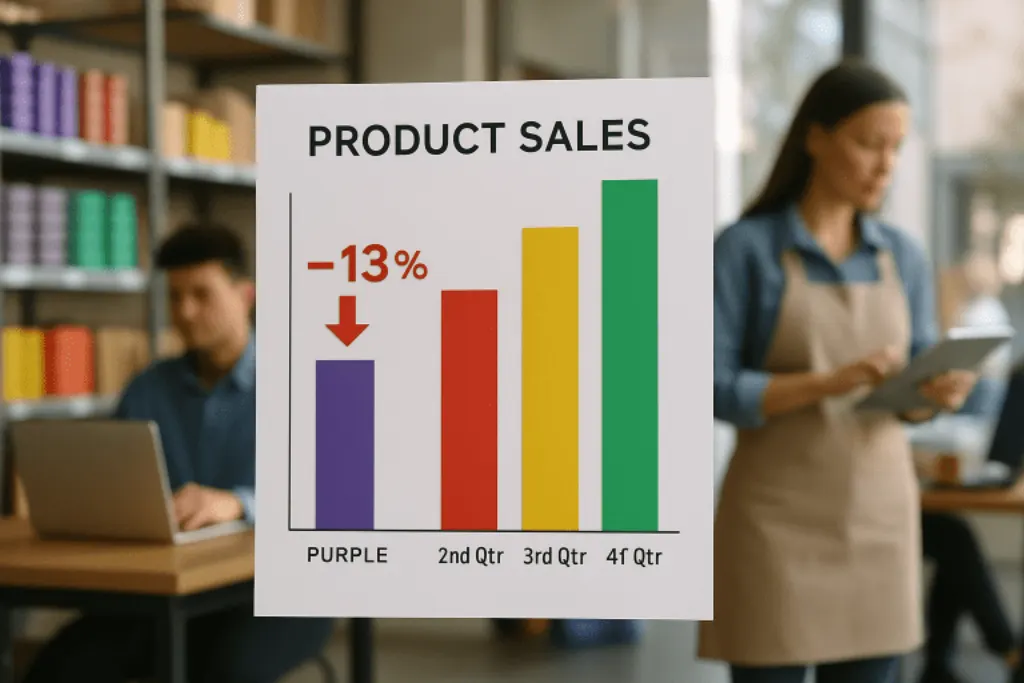
Purple’s sales fell 13% in the first quarter, driven by a slowdown in wholesale and online channels.
Contents8
Purple’s sales suffered a significant hit in the first quarter of 2025, declining significantly by 13.2% year-over-year to $104.2 million. This decline was primarily driven by a marked slowdown in its wholesale and online channels. While the wholesale channel declined by 24%, the online segment saw an 8% reduction. Despite this decline, Purple managed to improve its gross margin, bringing it to 39.4%, a notable increase of 460 basis points compared to 2024. This significantly improved margin performance highlights more efficient cost management. The Impact of Sales Channels on Purple’s Financial Results Analysis of Purple’s financial results reveals a worrying reliance on its traditional and digital sales channels. With a significant decline in its wholesale and online sales, the company is facing serious challenges in stabilizing its revenues. Weakening demand in these channels has not only affected overall revenue but also threatened the brand’s financial integrity. Wholesale, in particular, once a cornerstone for Purple, has experienced a drastic 24% decline. This decline reflects broader market trends, where retailers are reducing orders under pressure from bloated inventories and fluctuating consumer demand. A more granular analysis reveals that this decline is also linked to increased competition in the mattress and furniture sector, where offerings are continually expanding and enriching.
Discover how Purple’s sales fell 13% in the first quarter, due to a significant slowdown in its wholesale and online channels. Analyze the factors that contributed to this decline and the outlook for the future. The Influence of Market Trends Current trends in the bedding and furniture market are significantly influencing demand. Beyond the impact of excessive stockpiling, consumers are showing increasing interest in more eco-friendly and personalized offerings, prompting companies like Purple to review their product strategy. Furthermore, with the rise of e-commerce, purchasing preferences are shifting toward more direct-to-consumer business models, a reality that Purple must address to recover.
The online sales market also presented a distinct challenge. While the reduction was less severe, at an 8% drop, it is still a concern. This phenomenon reflects the growing saturation of the e-commerce market, where competition is fierce and shoppers are often on the lookout for the best deals, thus emphasizing Purple’s need to review its digital value proposition. https://www.youtube.com/watch?v=HTS1JGmbVmw Deepening Partnerships to Boost SalesFaced with these challenges, Purple has chosen to strengthen its strategic alliances to increase its market visibility and stabilize its sales. A key agreement was the duplication of its product footprint in Somnigroup International’s Mattress Firm stores, increasing the number of its locations from 5,000 to 12,000 points of sale by the end of 2025 and early 2026. This strategy aims to maximize Purple’s physical visibility, making brand recognition more tangible and thus stimulating wholesale sales.

To offset the drop in sales, the company is also leveraging an expanded partnership with Tempur Sherwood, a subsidiary of Tempur Sealy. Tempur Sherwood has obtained exclusive rights to assemble certain Purple products for Mattress Firm. This collaboration aims not only to strengthen production capacity but also to increase the appeal of Purple mattresses to Mattress Firm’s existing customer base, a crucial strategy for revitalizing sales. To illustrate this initiative, consider a table outlining Purple’s strategic changes:
Strategy
Objective Predicted Impact Increase Points of Sale
Increase In-Store Sales
Partnership with Tempur Sherwood Strengthen Product Appeal Increase Consumer Demand
Optimize E-Commerce
Capture a Broader Audience
Strong Resurgence of Online Sales
Targeted paid advertising campaigns

Financial Adjustments and Exploration of Strategic Alternatives
Despite the challenges, Purple is showing significant progress compared to its past financial losses. Although the company recorded a net loss of $19.1 million for the quarter, it is worth noting that this situation improved from the $50.2 million loss last year. Its operating deficit stood at $14.5 million, a positive contrast to the $23.1 million loss last year. Flexibility in a Dynamic EnvironmentPurple’s flexibility is a key asset in the face of market uncertainties. In response to potential trade disruptions due to tariff policies, Purple remains vigilant. The company continues to produce its mattresses in the United States, limiting the scope for additional costs associated with the 15% imports. CEO Rob DeMartini estimates the annual tariff impacts at approximately $10 million, emphasizing that the company is seeking sourcing alternatives while reevaluating its pricing strategies to mitigate potential cost increases.
Continuous Analysis of Tariff Policies
Alternative Sourcing to Reduce Costs Flexibility Through a Vertically Integrated Model Ultimately, the company remains confident in its ability to adjust to unpredictable challenges and convert obstacles into growth opportunities.
Purple’s Recovery and Future
- As Purple seeks to regain stability, the company is engaged in a review of its strategic alternatives. The Board of Directors has initiated a thorough review of strategic options, including the potential sale of the company, a merger, or other financial transactions. These decisions, in the face of a saturated competitive environment, aim to optimize both shareholder value and brand sustainability.
- Strategic Options for Growth
- Considering such moves demonstrates proactive anticipation of current market trends and a readiness to pursue new directions to secure success. These decisions include:
- Option
- Description
Potential Benefits
Transfer of ownership to a new entity
Capital injections, potential synergies
Merger
Alliances with other companies
- Access to new markets, shared technologies
- Financial Review
- Redefining Financial Priorities
Improving Operating Margins
With this set of options, Purple hopes not only to overcome its current challenges but also to seize new avenues for further growth. Approaching the future with flexibility and strategy equips Purple to weather headwinds while laying the groundwork for future success.
Discover how Purple’s sales fell 13% in the first quarter, impacted by a notable slowdown in wholesale and online channels. Our analysis and business impacts.

Read next
 E-commerce news
Costco’s third-quarter results beat expectations, with online sales up
Costco Wholesale Corporation released its financial results for the third quarter of 2025, pleasantly surprising analyst
 E-commerce news
Prime Day generated over $24 billion in U.S. e-commerce sales, with a 3,300% increase in traffic driven by generative AI
Prime Day, promoted by Amazon as an essential annual celebration for online shoppers, has once again established itself
 E-commerce news
German e-commerce sales rise for first time since 2021: advocacy organization
Since 2021, German e-commerce has seen a marked resurgence, reported by an advocacy organization. This period has seen t
 E-commerce news
Online commerce sees biggest slowdown in over a decade as tariffs disrupt e-commerce: survey
Online commerce is experiencing an unprecedented slowdown. This phenomenon is largely due to tariff policies, notably in