Walmart and ChatGPT’s Deal: A Warning to All Small E-Commerce Businesses: Your Website Is at Risk in the Age of Artificial Intelligence

Contents5
In 2025, the winds of innovation are blowing strong through e-commerce, bringing with them mountains of change and challenges. The recent partnership between Walmart and OpenAI, creators of ChatGPT, has sent shockwaves through the industry. This agreement marks a major advancement in the digital shopping experience thanks to the integration of powerful and agile artificial intelligence (AI). Small e-commerce businesses, in particular, must prepare for this new era where their website may no longer be the center of the customer experience. As large companies like Amazon, Shopify, Prestashop, BigCommerce, Magento, WooCommerce, and Cdiscount prepare for this digital transformation, let’s examine how this alliance is transforming the retail landscape and what it means for small businesses.
Related reading : Shopify and Etsy get an unexpected boost from ChatGPT
Related reading : OpenAI and Shopify ready to partner with ChatGPT’s shopping integration directly into…
Walmart and ChatGPT: A Revolution in the Shopping Experience
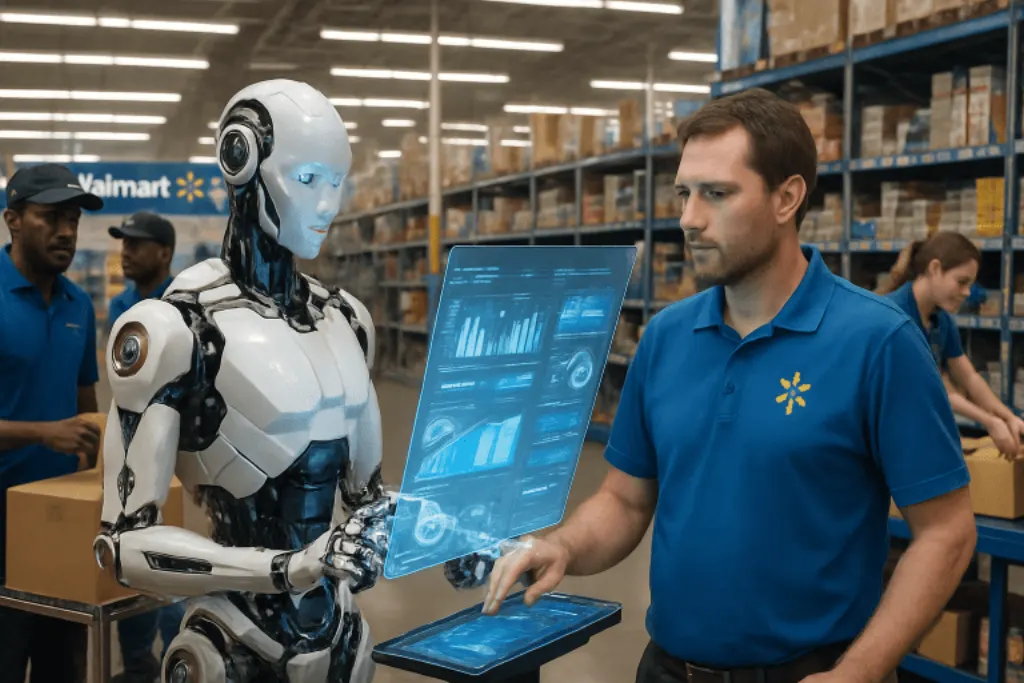
Walmart has taken a decisive step by partnering with OpenAI to leverage ChatGPT, thus transforming the consumer experience. The integration of ChatGPT allows customers to conduct purchasing transactions intuitively and seamlessly, like a human conversation. This strategic move perfectly illustrates AI’s ability to transcend the traditional limitations of e-commerce platforms. But what implications does this have for the retail sector? Primarily, AI opens the door to a new model where digital platforms are no longer just storefronts, but become interactive partners for customers.
For the past four months, retail giants like Amazon and Walmart have been scrambling to establish the infrastructure needed for these AI-based purchasing agents. This dynamic only confirms that the changing paradigm of AI in commerce is much more than a passing fad. While market research highlights that in electronics, buyers ask 50% more questions before purchasing compared to other categories, AI offers effective support that significantly increases engagement and conversion rates, ten times more than traditional sites.
Complex purchases, which require special attention as well as numerous services, are already migrating to conversational interfaces. Consumer attitudes show a preference for a guided shopping experience, where AI responds instantly, recreating the experience of interacting with a knowledgeable advisor. This evolution transforms the primary function of websites which will become more of a space for brand presentation and trust creation, while the heart of purchasing will shift to AI-driven environments like ChatGPT.

Related reading : OpenAI’s next revolution: integrating e-commerce into ChatGPT
Small businesses: between opportunities and threats
The alliance between Walmart and OpenAI raises a crucial realization for small businesses operating online. In the era of artificial intelligence, these businesses face a formidable challenge: successfully adapt or risk seeing their online presence become obsolete. Websites that once served as a platform for discovery and the purchasing process will no longer be the only transaction channels. With the rise of AI-powered shopping agents, small businesses must expand their digital horizons.
Implementing a chatbot represents a strategic opportunity to introduce interactivity into the user experience. However, the fear is that without adaptation, the direct and valuable relationships that SMEs have built with their customers will be compromised. To stay abreast of these developments, it is crucial for these small businesses to revise their digital strategy to take advantage of AI agents. This would allow them to focus on strengthening their online presence not just as a point of sale, but by creating memorable and differentiated experiences. Strengthen your online identity to stand out.
- Adopt AI technologies to enrich the user experience.
- Maintain an authentic relationship with consumers.
- Create exclusive and engaging content.
- The proactive implementation of artificial intelligence is already influencing consumer behavior, which prioritizes simplicity and personalization, which can only be delivered by intelligent systems. For small businesses, mastering these new tools is essential to thrive and, potentially, outpace some of the giants in their own right.
Conversational Commerce: The Evolution of Online Shopping The rise of conversational commerce via platforms like ChatGPT is a reality that businesses must address. This engagement model is redefining the way consumers approach online purchases, significantly reducing friction. Thanks to seamless and natural interactions, consumers can chat with a virtual assistant as intuitive as an in-store salesperson. This purchasing method isn’t just a trend; it’s central to the digital transformation of commercial interactions. Consumers are seeking increased personalization that goes beyond simple product recommendations. AI-powered conversational commerce allows the customer journey to be tailored to their needs and history, rather than a pre-established structure. This flexibility is one of the major advantages attracting consumers to these new services.
Reduced purchasing time thanks to immediate responses.
Increased customer satisfaction thanks to optimal personalization. AI facilitates complex purchasing decisions. Purchasing AspectTraditional Website
Conversational Commerce
- Personalization
- Limited
- High
Increase customer interaction. Optimize customer satisfaction through personalized services. Reevaluate online platforms to meet new expectations.

Related reading : Could ChatGPT’s deal with Shopify hurt Google’s search business?
Looking ahead to 2025, the challenges are multiplying for online sales platforms as they respond to new consumer expectations. With Walmart and ChatGPT at the forefront, AI is completely redefining the user experience, reinventing the original role of the website. Platforms like Shopify and Prestashop must adapt quickly to fill these technological gaps with bold innovations.
The quest for optimized customer interaction requires an urgent need to reshape digital infrastructures and fully embrace the AI revolution. The immense potential of AI now lies in its ability to analyze data to predict preferences, recommend products, and simplify purchases like never before. But this also requires a deep understanding of expectations for greater personalization of the user experience.
Continuous improvement of AI tools for an optimal customer experience. Adoption of AI for personalized and simplified searches. Constant evaluation of new commerce technologies. https://www.youtube.com/watch?v=TnISDIDtgzI
Potential Solution
- Fragmented communications with consumers
- Unifying platforms with AI
- Reliance on traditional data analysis
Empowerment through scalable AI agents
Limited personalization of the user experience Leveraging AI for seamless recommendations Ultimately, the urgency of digital transformation is imperative for all players in the online commerce sector. For both small businesses seeking to stand out in a highly competitive environment and large groups seeking to strengthen their leadership, the key lies in the resolute and proactive adoption of AI to serve the customer. By embarking on this new adventure, each retail player is positioning themselves to capture the essence of the next digital revolution. /le-marche-des-biens-de-consommation-courante-fmcg-devrait-croitre-de-4566-milliards-usd-entre-2024-et-2028-propulse-par-la-preference-pour-le-commerce-et-une-evolution-du-marche-stimulee-par-l/
Read next
 E-commerce news
Small businesses thrive on e-commerce platforms
In an increasingly connected world, small businesses are shaping a new future thanks to the rise of e-commerce. Renowned
 E-commerce news
China seeks to regulate e-commerce platform commissions to support small businesses
In a world of constant digital transformation, China has decided to take significant steps to regulate the commissions o
 E-commerce news
Walmart is warning of potential price increases due to tariff uncertainty as online sales continue to grow.
Retail giant Walmart is confronting its customers with potential price increases as a direct result of growing uncertain
 E-commerce news
Walmart is banking on super-intelligent artificial agents to boost its e-commerce growth
In a bold strategic shift, Walmart, a titanic retail empire, is reinventing its digital destiny by equipping itself with