What is a fully qualified domain name? FQDNs explained
Contents5
In the vastness of the web, a website’s address plays a crucial role. It’s a bit like a house’s postal address; without it, it would be impossible to precisely locate a site. But did you know that beyond a simple domain name, there is something called a fully qualified domain name (FQDN)? In this article, we’ll delve into the mysteries of these complete web addresses and explore how they structure and secure our digital interactions.
Understanding the Concept of FQDN: What Is It For?
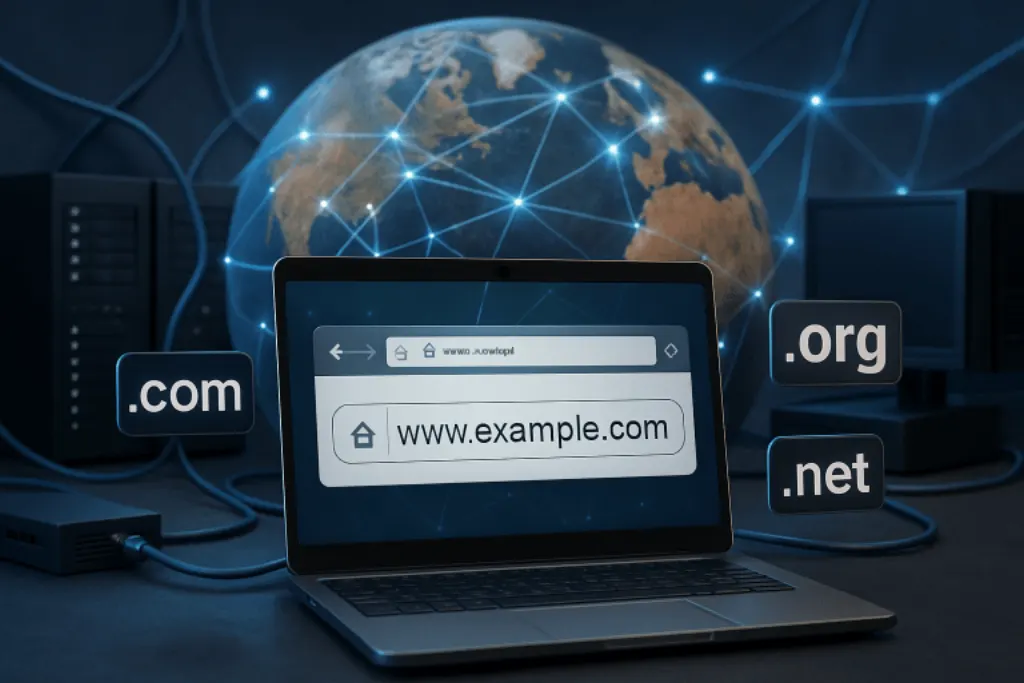
A fully qualified domain name, or FQDN, represents the complete and specific address of a website or a connected resource, such as a server. Imagine typing www.shopify.com into your browser: you’re already using an FQDN! This name allows web browsers to precisely locate a server among a multitude of connected machines. The concept is therefore essential to ensure correct and secure access to a website, ensuring that the user arrives at the right place.
The primary value of an FQDN lies in its **precision.**When writing an address like « Main Street » to send a letter, the post office won’t be able to respond without additional details. Similarly, to locate a website, each component of the FQDN is essential in translating this human address into a machine-readable level. The Domain Name System (DNS) handles this translation, allowing browsers to convert an FQDN into an IP address, and thus locate the server hosting the website.
- Top-level domain (TLD): This is the last part of the FQDN, often « .com », « .org », or « .net », which defines the general category or region associated with the domain name. Second-level domain (SLD):
- Just before the TLD, the name of the company or organization is often found, for example, « shopify » in « www.shopify.com ». Subdomains
- : These are specific addresses within a primary domain, such as “blog.yoursite.com” for a blog linked to your site. Hostname
- : The initial element of the FQDN, often « www » to indicate content intended to be displayed as a web page. It could also be « mail » for an email server. Discover what a fully qualified domain name (FQDN) is and its importance in the world of the internet. This detailed explanation will help you understand the structure of FQDNs and their role in network operation.

The FQDN and its difference from the URL Often, an FQDN can be confused with a URL, but these two concepts are distinct. The URL, or Uniform Resource Locator, includes a FQDN
but adds details about how to access a resource. For example, a URL typically begins with « http:// » or « https:// » to indicate the communication protocol to use.
Consider the following example: The URL: https://www.mysite.com/products
indicates not only the website (the FQDN « www.mysite.com »), but also the specific path to the site’s products page.
- The FQDN: www.mysite.com expresses only the location, without including the specific method or path to reach internal content.
- In this sense, an FQDN can be seen as a precise landmark in a vast network where each component contributes to secure and direct navigation. https://www.youtube.com/watch?v=iKzxjnsnoCE The Notable Benefits of Using FQDNsUsing FQDNs is essential for various aspects of website and online resource management. When you create a cutting-edge e-commerce site
or configure a secure database, FQDNs play a vital role in requiring browsers to reach precisely the correct server.
Securing connections
: SSL certificates, used to secure HTTPS connections, are issued by connecting directly to FQDNs, guaranteeing the integrity of the data exchanged. Diversification of services : With specific subdomains, you can easily distinguish different parts of a site, such as « store.yoursite.com » for the store and « mail.yoursite.com » for the email service.
Easy remote access
- : With a FQDN
- , regardless of our location, we remain able to access a server, as long as the Internet connection is available. Search Engine Optimization
- : Well-structured FQDNs help the algorithms of search engines like Google to better index and understand the function of each part of your site, favoring its positioning. learn what a fully qualified domain name (fqdn) is and its importance in the functioning of the internet. this clear explanation will allow you to understand the elements that make up a fqdn and its crucial role in accessing online resources. **By giving businesses tools to segment and secure their content, FQDNs make it easier to manage and scale online resources.**Set up a fully qualified domain name
- The process of obtaining and setting up a FQDN

domain
. You can opt for service offerings such as OVH, Gandi or &1 IONOS, to name just a few among the many providers available in 2025.
Then you must: Choose one hostname appropriate, frequently « www » for content accessible via the web, or « mail » for an email server.Use a hosting provider such as Amen or LWS, which offers DNS configuration options that include the full address.
Configure the various components of the FQDN in your DNS manager to ensure address clarity. For example, for Infomaniak, the platform offers a user-friendly interface where each subdomain or service can be quickly configured.
- By doing this, you customize the location and operating mode of your digital services, while ensuring clear visibility for your visitors and search engines. https://www.youtube.com/watch?v=WCryvJByxlE FQDNs in the professional environment and local networks
- While we often think of
- FQDNs
in connection with public websites, they also play a vital role in professional environments and local networks. In corporate contexts or when IT connects to servers remotely, the FQDN effectively manages access. Here’s how FQDNs fit into these structures:
: Network administrators like those at Hostinger or Strato use FQDN-based rules to precisely define which machines or services should interact with each other.
Resource Location : In an office where each file server or machine has its own FQDN, employees can access the documents they need for their tasks from anywhere. Increased Security
: A properly configured FQDN means firewalls and other security measures can be implemented without hassle, as the addresses leave no room for ambiguity.
- Professional integration systems like those from NFrance or PlanetHoster often offer options for administering these advanced management methods, allowing businesses to leverage FQDN capabilities for secure data sharing and collaboration. Discover what a fully qualified domain name (FQDN) is and its importance in the world of the web. This clear and concise explanation will help you understand the structure of domain names and their role in the internet.
- Finding the FQDN of your computer or server Deceptively simple, checking a machine’s FQDN varies depending on the operating system used. Whether you’re using macOS, Windows, or Linux, each system offers a distinct method for accessing this vital information. This everyday task in professional contexts is made easier by the following steps:
- Mac (macOS Sequoia 15.x): Open the Apple menu, choose System Settings, then Sharing. The command line « hostname -f » in Terminal allows you to quickly display the FQDN. Linux: A simple entry of « hostname -f » in Terminal exposes the information.
Windows 11: Go to the Settings app, choose System, then About to locate your **domain name.**Having a recognized and functional FQDN for every computer and server is essential for modern business interactions, allowing teams to collaborate and share resources with remarkable efficiency.

Read next
 Business
Discover the secret to buying the perfect domain name in the blink of an eye!
Guide to buying a domain name If you are planning to start a blog, online store or website, you will first need to purch
 Shopify
Shopify (SHOP) in sharp decline: what investors absolutely need to understand in light of the market trend
Shopify's Fall: An Analysis of the Underlying Causes Shopify's (SHOP) recent plunge in the stock market has taken many i
 Shopify
Shopify Inc. (SHOP): Attracting Investor Attention – What You Need to Know
Shopify and the World of E-commerce: An In-Depth Analysis In 2026, e-commerce giant Shopify continues to redefine the e-
 Shopify
Shopify stock falls 7% amid interest rate uncertainty: what investors are now watching
Shopify Stock's Fall: Economic Context and Market Fluctuations On January 30, 2026, Shopify's stock experienced a sharp