Amazon expands its multi-channel fulfillment service by integrating Walmart, Shopify and Shein
Contents5
In the year 2025, the expansion of Amazon’s logistics empire has never been more impressive. By integrating retail giants such as Walmart, Shopify, and Shein into its Multi-Channel Fulfillment (MCF) service, Amazon is radically changing the e-commerce landscape. The company’s ambitions extend far beyond its role as an online retailer to become the world’s leading logistics network, reaching every corner of the globe. This evolution raises important questions about competition, technological innovation, and logistics efficiency, while also offering merchants new opportunities to grow and reach a global customer base. So, what does this really mean for sellers and consumers? How is Amazon changing the rules of the e-commerce game? Amazon and the Integration of Walmart, Shopify, and Shein: A Logistics Revolution
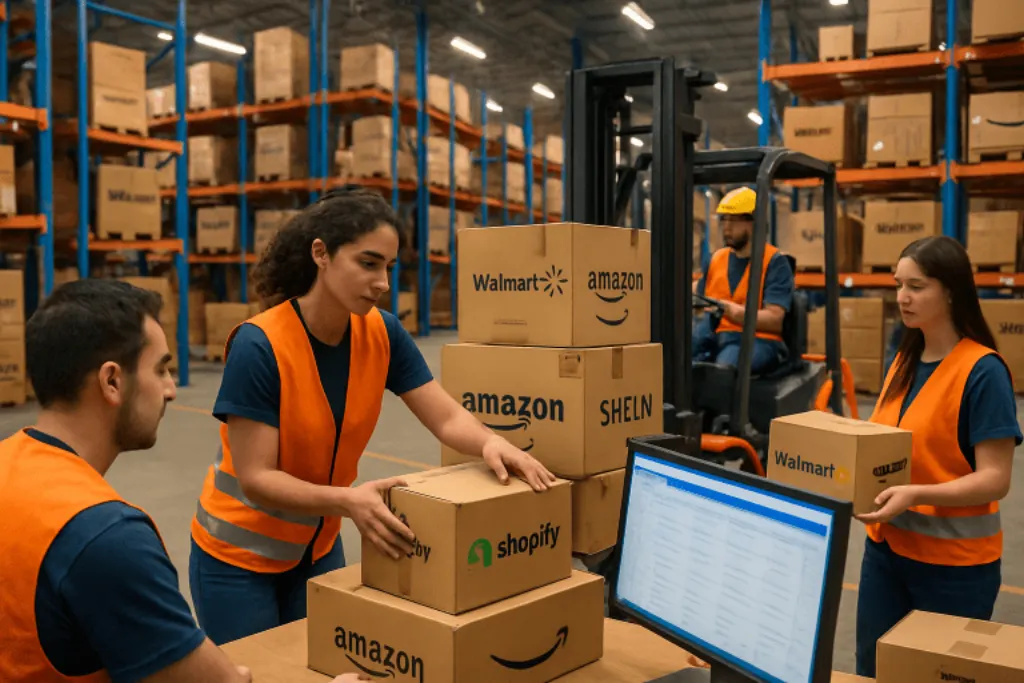
In March 2025, Amazon made a resounding announcement: its Multi-Channel Fulfillment (MCF) service is expanding to support merchants selling on flagship platforms such as Walmart, Shopify, and Shein. This initiative demonstrates Amazon’s commitment to positioning itself as the logistics backbone of global commerce. The timing couldn’t be better, as each of the aforementioned sales platforms represents a retail giant with millions of active users.
With this expansion, sellers using MCF see their logistics simplified. Order picking, packing, and delivery operations can now be managed by Amazon, wherever they are placed. Thanks to this standardized logistics, merchants can maintain a single inventory for all their sales channels, reducing storage costs and the need to maintain excess inventory. For companies such as Walmart, Shopify, and Shein , integration into a network as powerful as Amazon results in unparalleled fulfillment efficiency and improved customer satisfaction. Analysis shows that when sellers use both Multi-Channel Fulfillment and Fulfillment by Amazon (FBA), they see an average 19% decrease in out-of-stock rates, with a 12% increase in inventory turnover. This demonstrates the significant impact of the synergy of Amazon’s logistics services. These figures underscore the importance of responsiveness and efficiency, two crucial elements in the modern customer experience.
Amazon is expanding its multi-channel fulfillment service by now integrating Walmart, Shopify, and SheIn, allowing sellers to easily manage their orders and logistics across multiple platforms with a comprehensive and efficient solution. Supply Chain Optimization: A Challenge for Contemporary BusinessesThis partnership is part of Amazon’s broader strategy to ensure global supply chain dominance. The company recently launched its Global Warehousing and Distribution service, allowing merchants to store bulk products near manufacturing sites, often at a reduced cost. This includes locations in strategic locations such as China and Vietnam. Integrating this service helps it stay ahead of the competition by reducing shipping times and making products available to customers faster and more reliably. **In the long term, Amazon plans to expand its warehouse facilities in all major global manufacturing centers, potentially transforming the dynamics of current warehouses. The visible impact is already measurable: products move from Amazon’s global distribution center to its local fulfillment network seven days faster than before. This rapid access to products helps boost sales, particularly during peak demand days like Black Friday or Christmas.**Multichannel logistics is a major challenge for modern businesses. In a saturated market where transit time is becoming as valuable as the product itself, having such a streamlined supply chain represents an undeniable competitive advantage. By integrating these new sales platforms, Amazon is ensuring greater participation in a rapidly expanding market, as this report explains. https://www.youtube.com/watch?v=R8RlK2HhL8w
Technology at the heart of Amazon’s logistics services

The impact of this initiative is significant. Initial results show that merchants have reduced the time spent on customs paperwork by more than 50%. Ensuring products arrive quickly and without customs complications is an ongoing challenge that, if managed well, radically transforms the seller-customer experience.
Amazon also continues to expand its global transportation routes, directly connecting production centers to popular destination countries for its merchants. This global logistics system includes ocean and air transportation options from hubs in China and Hong Kong to the United States, as well as across Europe. By 2026, Amazon Global Logistics is expected to cover 96% of inbound volume shipped to FBA, transforming delivery times and conditions. **Amazon is expanding its multi-channel fulfillment service by now integrating the Walmart, Shopify, and SheIn platforms, providing sellers with centralized and optimized logistics to easily manage their orders across multiple sales channels.**GenAI and Inventory Optimization
Amazon’s use of GenAI isn’t limited to customs clearance. Advanced AI software also assists with inventory management and order fulfillment, including predicting which items will need to be restocked. These predictions are based on the analysis of past consumer trends, correlated with current purchasing behaviors. The result is a more agile supply chain that’s less prone to disruptions.
These technologies also play a major role in personalizing the user experience, influencing product recommendations and marketing strategies. Platforms like Shopify have already demonstrated how data can be leveraged to increase sales and improve customer satisfaction. The challenges of this expansion for Amazon and sellers While the integration of Walmart, Shopify, and Shein into Amazon’s MCF represents a major strategic advancement, it is not without its challenges. The main challenge lies in managing such a vast and complex network. Coordinating thousands of product lines and managing consumer expectations across multiple platforms requires absolute precision and unparalleled flexibility.
For sellers, the opportunity is there, but it requires rapid adaptation to these constantly evolving logistics technologies and processes. Working with giants like Cdiscount, Rakuten, eBay, La Redoute, AliExpress, and FNAC also requires a detailed understanding of local preferences and different pricing and regulatory regimes. The increased influx of data also requires meticulous management to optimize the customer journey and maintain premium service quality.
The Future of Commerce and Amazon’s Role in the Global Logistics Landscape
Over the years, Amazon has positioned itself not only as a key player in e-commerce, but also as the leading provider of integrated logistics solutions.

The innovation and continuous improvement of these services will benefit not only Amazon, but also small and large businesses seeking to compete in international markets. Amazon no longer simply sells products; it aims to become the ultimate e-commerce facilitator. The integration of advanced technologies, coupled with an optimized global transportation network, is transforming once-competitive sales platforms into strategic partners.
In this context, partnering with Amazon for multichannel sales and logistics management may well become the norm rather than the exception, as influential articles in
Le Siècle Digital show. However, companies must actively engage in adapting and optimizing their own supply chains to maximize the benefits of this alliance and effectively meet dynamic consumer expectations. The coming months and years will undoubtedly be marked by new alliances and innovations that will shift the current paradigm. But already, with this ambitious expansion of its Multi-Channel Fulfillment service, Amazon once again confirms that it is setting the rules in the multi-channel logistics sector.
Amazon is expanding its multi-channel fulfillment service by now allowing the management of orders from Walmart, Shopify, and SheIn. Take advantage of simplified and efficient logistics to develop your e-commerce business across multiple platforms.

Read next
 Shopify
Shopify expands near Amazon with new office in Bellevue
The online commerce landscape in 2025 is enriched by a new strategic development from Shopify, the Canadian e-commerce g
 E-commerce news
Amazon unveils primary care service in your city: the e-commerce giant expands its healthcare network
Amazon, already omnipresent in our daily lives through its e-commerce, marks a new turning point with the launch of its
 Shopify
OpenAI expands its list of shopping search partners with quiet Shopify integration
In a world where e-commerce continues to evolve, OpenAI is taking a bold step by quietly integrating Shopify into its sh
 Shopify
Coinbase Expands Services Through Shopify Partnership for Stable Cryptocurrency Payments
In a resolutely forward-looking movement, Coinbase and Shopify are jointly making a new digital footprint. By partnering