Amazon injects $233 million to boost e-commerce in India
Contents6
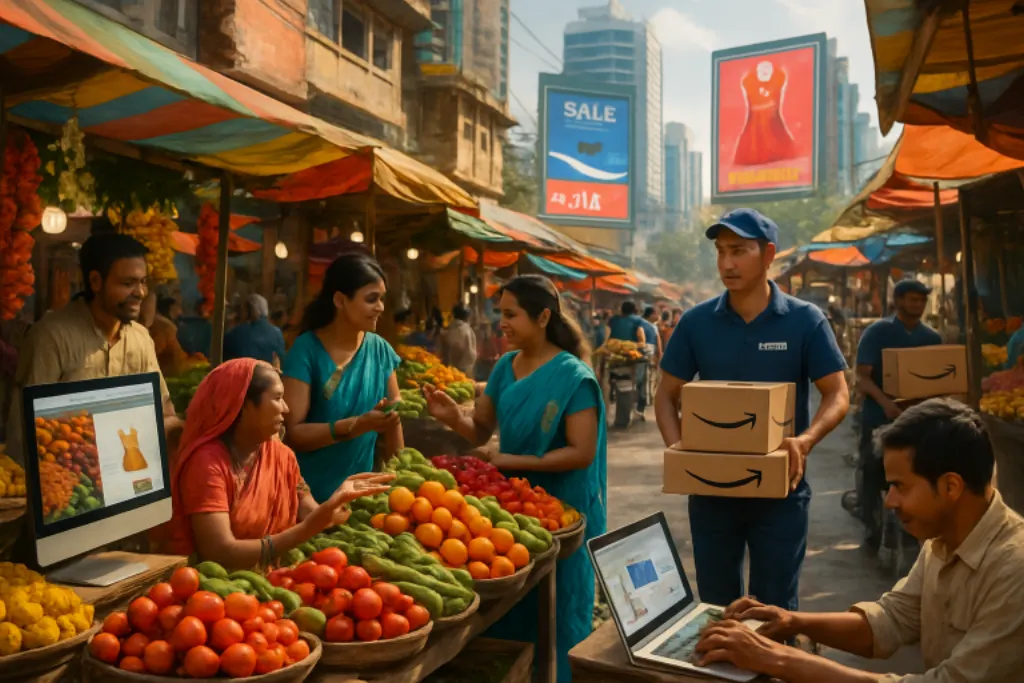
Amazon persists and signs in India. The American e-commerce giant has announced it is investing $233 million in the subcontinent to modernize and expand its infrastructure and services. This investment comes at a time of intensifying competition, particularly with local players and giants such as Walmart, owner of Flipkart. Amazon’s objective is clear: to improve its presence and performance in the Indian market, one of the most dynamic in the world with its 1.4 billion inhabitants. Its focus includes significant improvements to its processing capabilities, better order fulfillment speeds, and a more efficient logistics network.
Amazon seeks dominance in the Indian market
Amazon’s decision to inject $233 million into the Indian economy is not insignificant. India, with its population of approximately 1.4 billion, represents a market of considerable opportunity for e-commerce companies. However, this market is already highly coveted by many local and international players. Amazon is seeking to increase its market share by increasing its operational capacity and improving its supply chain. This includes upgrading warehouses, developing innovative software to facilitate delivery driver navigation, and protecting employees.
Faced with increasing competition, Amazon must stand out. Amazon has emphasized that this investment will be crucial for its expansion in India, especially given the rise of companies like Flipkart, Myntra, Snapdeal, and other emerging players like Ajio and Paytm Mall. To establish a lasting presence, Amazon intends to reach all PIN codes in the country through strengthened logistics and a denser distribution network.
In 2025, Indian consumers will be more connected and demanding than ever. To meet these needs, Amazon is focusing on a strategy of continuous improvement of its services, allowing it to guarantee superior service. This bet on logistics innovation could well pay off and allow Jeff Bezos’s company to gain even more loyal customers.

Modernizing infrastructure and services to attract customers
Improving logistics infrastructure is at the heart of Amazon’s plan in India. With a vast distribution network to establish, the company is looking to develop new technologies to assist its delivery drivers in their daily tasks. These technologies include improved navigation tools and improved employee safety. Additionally, Amazon provides rest areas for delivery drivers, financial assistance, and scholarships for employees’ children to ensure their well-being.
Amazon not only aims to retain its employees but also attract new talent by offering a safe work environment and competitive benefits. This strategy aims to reduce turnover and increase employee engagement, thus contributing to the overall efficiency of its operations.
These initiatives will result in improved delivery speed and efficiency, providing customers with a seamless shopping experience, which is essential for retaining an increasingly demanding customer base. By placing an emphasis on user experience, Amazon is leaving nothing to chance in conquering this strategic market.
Fierce Competition in Indian E-commerce
The Indian e-commerce market is far from smooth sailing. Several local and international companies are vying for leadership. Walmart-owned Flipkart is a powerful rival, with strengths such as fast-track commerce, which already accounts for 20% of the market. Other players such as SoftBank-backed Meesho, as well as local conglomerates like Reliance Industries and Tata Group, are also joining the fray.
The competitive landscape is therefore particularly intense. Each company is seeking to capitalize on a growing market characterized by an increasingly tech-savvy and affluent population. This competition drives innovation and forces companies to constantly innovate.
In response to this fierce competition, Amazon must adopt both a proactive and reactive approach to adapt to rapid market changes. By focusing on customer satisfaction and resource optimization, Amazon hopes to maintain its leadership position despite the challenges.
Amazon’s Strategies to Maintain Its Dominant Position
To stay ahead of the competition, Amazon is deploying a multi-pronged strategy. The first is the continuous improvement of its logistics infrastructure, already initiated with its recent investment. The second is technological innovation. Amazon is developing artificial intelligence-based tools to optimize the supply chain and anticipate future market demands.
Artificial intelligence and machine learning play a crucial role in analyzing purchasing behaviors to personalize recommendations and improve the user experience. These technologies also enable Amazon to predict market trends and adjust its inventory accordingly, thereby minimizing stockouts and maximizing customer satisfaction.
- Warehouse Modernization
- Distribution Network Optimization
- Deployment of AI Technologies
- Improving the User Experience
- Personalizing Recommendations
By enriching its services and meeting growing consumer expectations, Amazon hopes to turn the challenges of the Indian market into opportunities. Fast and efficient delivery remain major competitive advantages, which the company intends to fully exploit. Discover how Amazon is investing $233 million to boost e-commerce in India, strengthening its market presence and providing new opportunities for local sellers and consumers.

Despite well-defined strategies, the path to dominance in the Indian market is fraught with challenges. These include local regulations, cultural diversity, and often uneven infrastructure in some rural areas.
Indian e-commerce regulations can be restrictive, limiting the ambitions of foreign companies. Furthermore, economic disparity and linguistic diversity require Amazon to design solutions adapted to different communities and income levels.
The Future of E-commerce in India and Amazon’s Role
In 2025, e-commerce in India is at a turning point. The rapid pace of technological innovation combined with the growing expectations of Indian consumers is transforming the e-commerce landscape. Amazon, with its massive investment and willingness to adapt to local needs, is well positioned to play a major role in this transformation. Amazon is working to fully integrate cutting-edge technologies into the Indian market, capitalizing on mobile network penetration and the rise of smartphones. By anticipating the needs of Indian consumers, Amazon intends not only to participate in the market’s growth, but to become a key player in it.
Year
Market Value
Read next
 E-commerce news
Retail investors ensure the success of the $604 million IPO of the e-commerce platform Meesho in India
In a rapidly changing global economy, India continues to surprise with the emergence of new digital platforms that are r
 E-commerce news
SoftBank remains a key player as Meesho’s $606 million IPO marks the first major e-commerce listing in India
The IPO of Meesho, an e-commerce platform in India, has generated considerable interest in the financial markets. Japane
 E-commerce news
India intensifies its fight against e-commerce with a new $200 million case targeting Walmart’s fashion arm, Myntra
Amid a series of stringent regulatory measures, India is intensifying its efforts to regulate the thriving e-commerce se
 E-commerce news
Amazon layoffs: India-based employees among those affected as the online retail giant cuts 16,000 jobs – all the details
E-commerce giant Amazon is going through a difficult period with the recent announcement of 16,000 job cuts. This decisi