Amazon’s supply-centric AI vs. Shopify’s demand-centric approach
Contents5
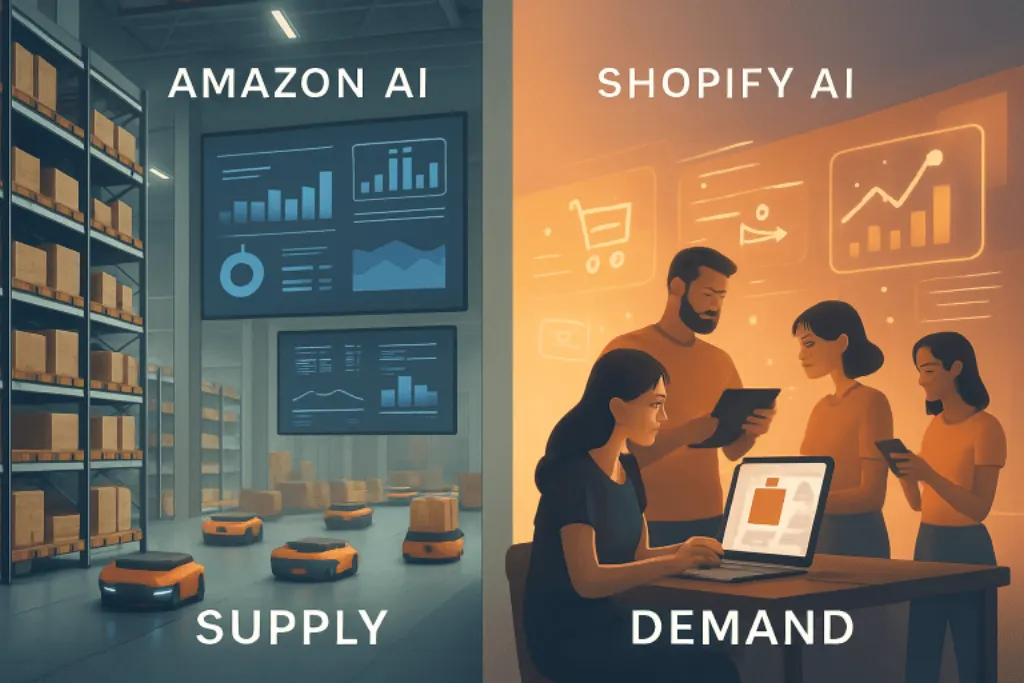
In the vast world of e-commerce, two giants stand out for their distinct approaches to artificial intelligence: Amazon and Shopify. Amazon, with its supply-side approach, focuses on operational efficiency and meeting consumers’ immediate needs. In contrast, Shopify, with its demand-side approach, aims to maximize its merchants’ performance. While Amazon is adopting a strategy of optimizing its supply chain and improving the user experience, Shopify is developing AI tools to help its sellers generate sales and personalize shopping experiences. Let’s discover how these companies are redefining the rules of digital commerce in 2025.
Related reading : Shopify or Amazon: Which e-commerce player currently dominates?
Amazon AI and Supply Chain Optimization
Amazon remains a pioneer in integrating artificial intelligence into every step of its supply chain. Thanks to solutions like Amazon SageMaker and Amazon Forecast, the giant offers optimized demand forecasting and inventory management that improve the accuracy of future volume predictions by 10 to 20%. It’s not just a matter of forecasting, but of ensuring that every product is exactly where customers need it. One of the major innovations is the introduction of DeepFleet. This AI model is revolutionizing the work of Amazon’s millions of robots, ensuring efficient task allocation and significantly reducing logistics costs. The work of these robots is just one of the many facets of this transformation, with customizations based on customer data playing an equally crucial role. Discover how Amazon’s artificial intelligence, focused on optimizing supply, differs from Shopify’s demand-driven approach, and explore the challenges and benefits of each strategy for e-commerce. **In addition, Amazon has developed an innovative system, « Wellspring, » which uses satellite imagery to identify ideal delivery locations. Imagine a system capable of analyzing weather conditions, traffic, and even local events to adjust its delivery routes accordingly. This technology embodies the idea of adaptive logistics, placing Amazon well ahead of its competitors.**All this AI-integrated infrastructure has the ultimate goal of accelerating deliveries while reducing costs, positioning Amazon as the undisputed champion of logistics efficiency. With more than 2.5 billion monthly visits, Amazon is inevitably focusing its efforts on meeting growing consumer demand.
The Impact on the Customer Experience **Amazon’s advancements don’t stop at warehouses. They extend to consumer-facing tools, as demonstrated by the evolution of the Alexa+ voice assistant. Incorporating AI, Alexa+ has been rolled out to millions of homes, transforming the way users interact with their digital environments. A multitude of customers also use the Rufus shopping agent, reinforcing the idea that AI is not just an auxiliary function, but actively transforming the customer experience.**Alexa+ allows ordering products based on past preferences.

Both initiatives illustrate how Amazon is improving real-time customer engagement.
https://www.youtube.com/watch?v=jK1VCdXqp\_o Ultimately, Amazon’s innovations aren’t just about technology, but about how that technology can improve consumers’ lives.Shopify and its focus on demand optimization
While Amazon focuses its AI on the supply chain, Shopify is dedicated to demand optimization. Shopify Magic, its AI-powered toolset, is dedicated to creating product descriptions, email campaigns, and dynamic marketing content, primarily aimed at improving merchant sales.
The Sidekick AI assistant is a perfect example of this strategy. This tool assists merchants with store management by automating manual tasks and providing relevant recommendations based directly on customer data analysis. Shopify Analytics bridges this gap by providing detailed reporting for businesses looking to quickly adapt their strategies to emerging trends. Discover how Amazon’s artificial intelligence optimizes supply by comparing its approach with Shopify’s demand-driven approach to improve inventory management and satisfy customers.
- As a platform, Shopify focuses on keeping its users competitive against giants like Amazon. Every element of the user experience is designed to be optimized by artificial intelligence. Take Shopify Plus, for example, which personalizes the presentation of e-stores. The goal is to ensure that each product is not only seen, but desired.
- Shopify Magic automatically creates compelling visual elements for products.
- Sidekick AI suggests actions based on sales history.
By integrating technologies like
Shopify Flow
, the platform eases the operational burden on sellers. This strategic choice is essential given Shopify’s direct reliance on its merchant network to maintain profitability.
AI Tools as a Lever for Business Success Differentiation in the e-commerce sector relies largely on the ability to offer users a frictionless shopping experience. For Shopify, this means an unwavering focus on automating tasks and improving workflows for its merchants. This includes AI tools that automate product categorization and provide intelligent solutions for customer interactions. Observing AI Demand Sensing

Comparing AI Strategies Between Amazon and Shopify
- Amazon and Shopify, although operating on the same digital playing field, embrace radically different strategies. One is rooted in supply chain optimization, while the other focuses on activating commercial demand.
- These differences can be summarized by their philosophy of control. For Amazon, control is exercised at the infrastructure level, particularly fulfillment and logistics centers. In contrast, Shopify entrusts this control to merchants, providing them with tools to maximize the effectiveness of product listings, marketing content, and customer interactions.
- Discover how Amazon’s supply-driven AI compares to Shopify’s demand-driven approach. It analyzes AI strategies to optimize inventory management and efficiently meet customer needs.
This contrast is also reflected in the companies’ financial results. For example, Amazon reported revenue of $167.7 billion in Q2 2025, with operating income of $19.2 billion, an increase largely attributable to efficiencies gained from AI-powered operations. Meanwhile, Shopify generated $2.68 billion in revenue during the same quarter, with 76% of its revenue coming from merchant solutions, signifying a heightened reliance on its merchants’ success. Company Q2 2025 RevenueOperating Revenue
Year Y Growth
Amazon
$19.2 billion
Shopify
$2.68 billion
N/A

Ultimately, the difference lies in how each company views its future growth. Amazon strives to become a global retail infrastructure, while Shopify is committed to being the hub for small businesses and entrepreneurs, providing them with the tools to compete and thrive in an environment dominated by e-commerce giants. The Impact of AI on the E-commerce Industry AI goes beyond simple algorithms; it is redefining how businesses interact with consumers and each other. For Amazon and Shopify, this transformation is realized through the optimization of internal processes and, most importantly, tangible improvements for end users. **However, this development raises important questions. How will these advances in AI impact competition? What will the long-term impacts be on jobs in the sector? As Amazon flexes its logistics muscles, Shopify is doubling down on efforts to ensure every business has the tools it needs to excel.**As e-commerce giants have shown, AI is not a threat, but an opportunity. It offers businesses a chance to embrace innovation and turn challenges into competitive advantages. With the playing field continuing to shift, the question remains how other players will emerge and which ones will change the rules of the game even more dramatically than today. The lessons learned in 2025 will lay the foundations on which future strategies will be built. The Future of Commerce with Artificial Intelligence
Read next
 Shopify
Google and Shopify are the top winners of 2025: as new strategic points of sale approach
The Rise of Google and Shopify in 2025 By 2025, the dynamics of the online retail market are transforming at breakneck s
 Shopify
Shopify revolutionizes print-on-demand with PrintKK integration
IN BRIEF Print-on-demand service Shopify allows connection with various applications on-demand printing for product cust
 Shopify
Paris de la Capitale : la démesure d’Amazon face à la rentabilité épurée de Shopify
La Déferlante Amazon : Démesure et Expansion en 2026 Dans le cœur vibrant de la capitale, Paris, l’ombre imposante d’Ama
 Shopify
Amazon ou Shopify : Quel Géant du E-Commerce Maximisera Vos Gains ?
Amazon contre Shopify : Une Confrontation sur la Scène du E-Commerce Dans un monde où le e-commerce règne en maître, deu