Chinese e-commerce giants ignore regulatory risks to pursue price wars in instant sales
Contents5
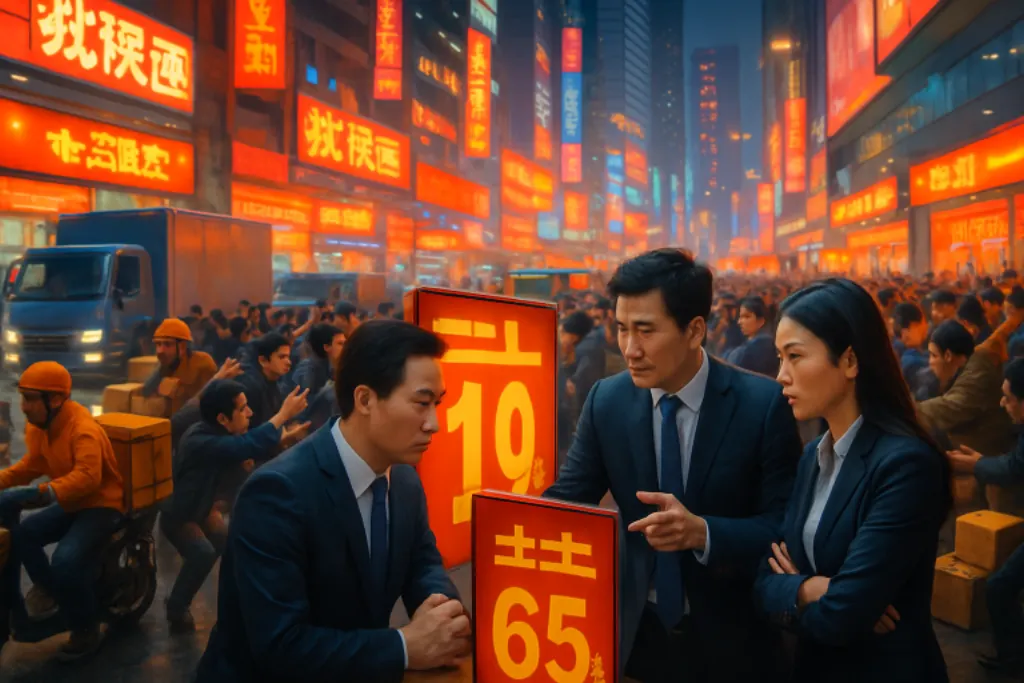
Fierce competition in China’s e-commerce sector shows no signs of abating, particularly in the booming « instant sale » space. Ignoring warnings from regulators, major platforms such as Alibaba, JD.com, and Meituan are investing huge sums to subsidize one-hour deliveries, turning the market into a battle for survival. This frantic race promises lucrative opportunities, but also raises concerns about deflationary pressures that could intensify in a tense economy driven by US sanctions and technology restrictions.
Related reading : E-commerce companies in China are in the grip of a price war: an in-depth analysis
Related reading : China’s e-commerce companies caught in the turmoil of a price war
The Stakes of the Instant Sale Price War in China
Chinese e-commerce giants such as Alibaba, JD.com, and Meituan are currently engaged in a fierce battle in the instant sale sector. The concept relies on the promise of ultra-fast delivery, often in less than an hour, and responds to a growing demand for immediate consumption. For consumers, this promises near-immediate service, making the act of purchasing even more accessible and appealing.
To understand the magnitude of this battle, it’s worth reviewing the financial efforts made by these platforms. They have invested nearly 200 billion yuan, or approximately $28 billion, to subsidize these express deliveries. For the end user, this translates into tempting offers: breakfasts, teas, and other treats that, thanks to these subsidies, are often free or at unbeatable prices.
This aggressive strategy allows these platforms to capture a significant market share, but it also raises legitimate concerns. Chinese authorities, traditionally firm on regulatory matters, have summoned the heads of the major platforms to remind them of the need for rational competition. Despite this, companies continue to move forward, convinced that instant sales are the future of e-commerce. Read more

The Economic and Social Consequences of this Instant Sales Frenzy
The Chinese economy, valued at over $19 trillion, is experiencing a period of moderate growth. In this context, the exponential growth of the instant sales sector is not without consequences. « Zero yuan purchases, » or free purchases, while well-received by consumers, are criticized for creating an economic bubble based on unsustainable subsidies. Moreover, these practices could intensify deflationary pressures, disrupting the country’s overall economic balance.
At the same time, on a social level, intense competition and pressure for fast deliveries also have repercussions on the workforce. Delivery workers, often under enormous pressure to meet deadlines, are the first to feel the human costs of this price war. This situation is raising growing concerns about their safety and working conditions. Read more.
Related reading : How is China’s ruthless e-commerce price war leaving sellers struggling to make ends meet?
The Regulatory Impacts of the Price War in China
Chinese authorities are no strangers to rigorous practices when it comes to maintaining market discipline. Instant sales, with their potential economic consequences, are no exception. The government has repeatedly summoned platforms such as Alibaba and Meituan, emphasizing the need for harmonious market development, meeting national economic aspirations while avoiding adverse effects.
A Xinhua publication highlighted the potential consequences of an unlimited subsidy market, calling it a « bubble market. » Editorialists have been clear: this race for discounts produces no lasting winners and risks undermining national economic stability. However, driven by a vision focused on the future of global e-commerce, companies appear to be maintaining a steady course toward significant ambitions.
The major regulatory challenge remains the balance between innovation and stability. While recognizing the benefits of instant sales, the Chinese government is determined to ensure that this innovation develops in a controlled and responsible manner. Additionally, heavy fines could be imposed on platforms that refuse to comply with local regulations, with particular emphasis on consumer protection and fair competition. Learn more

Challenges for logistics players and Europe
Beyond China, the rise of instant Chinese sales is also disrupting global logistics, particularly in Europe. The growing demand for fast-moving products poses new challenges for logistics systems, which must juggle an optimized supply chain to meet these new requirements.
In Europe, where imports of Chinese products continue to grow, infrastructure is under increasing pressure, with nearly 12 million Chinese parcels flooding European ports every day. Customs reform is inevitable to manage this unprecedented influx and ensure compliance and security standards. Read more.
The Future of E-commerce in the Face of the Rise of Instant Sales
With constant technological developments, traditional e-commerce is at a crossroads. The adoption of artificial intelligence and automated warehouses is seen as a path to increased profitability for instant sales, reducing operational costs while increasing efficiency. In this scenario, conventional e-commerce could be cannibalized, permanently transforming the online retail landscape. This rapid evolution also requires traditional players to reconsider their strategies to remain competitive in the face of this emerging threat from China.
Various players such as Alibaba and JD.com continue to restructure and invest heavily in advanced technologies to anticipate this evolution. The goal? Not only to dominate the local market but also to expand their influence internationally, particularly by having flexible platforms capable of responding quickly to fluctuations in global demand.
Read next
 E-commerce news
Chinese car dealers under pressure from price wars and competition from online sellers
The current price war in the Chinese automotive market has put dealerships in a critical situation. Between reduced marg
 E-commerce news
China-founded e-commerce giants Temu and Shein announce price increases due to tariffs
E-commerce platforms Temu and Shein, well known for their very attractive prices, recently announced an imminent price i
 E-commerce news
Chinese e-commerce giants Temu and Shein are strengthening their grip in Africa while Jumia is withdrawing from a new African market
Chinese Giants and the African E-commerce Landscape The e-commerce sector in Africa is undergoing a major transformation
 E-commerce news
Kmart, Target and Bunnings CEO slams Chinese e-commerce giants Shein and Temu: ‘Unfair’
In a global context where e-commerce is taking on unprecedented proportions, Chinese giants such as Shein and Temu are n