Costco remains stable while Walmart is betting heavily on its e-commerce transformation
Contents5
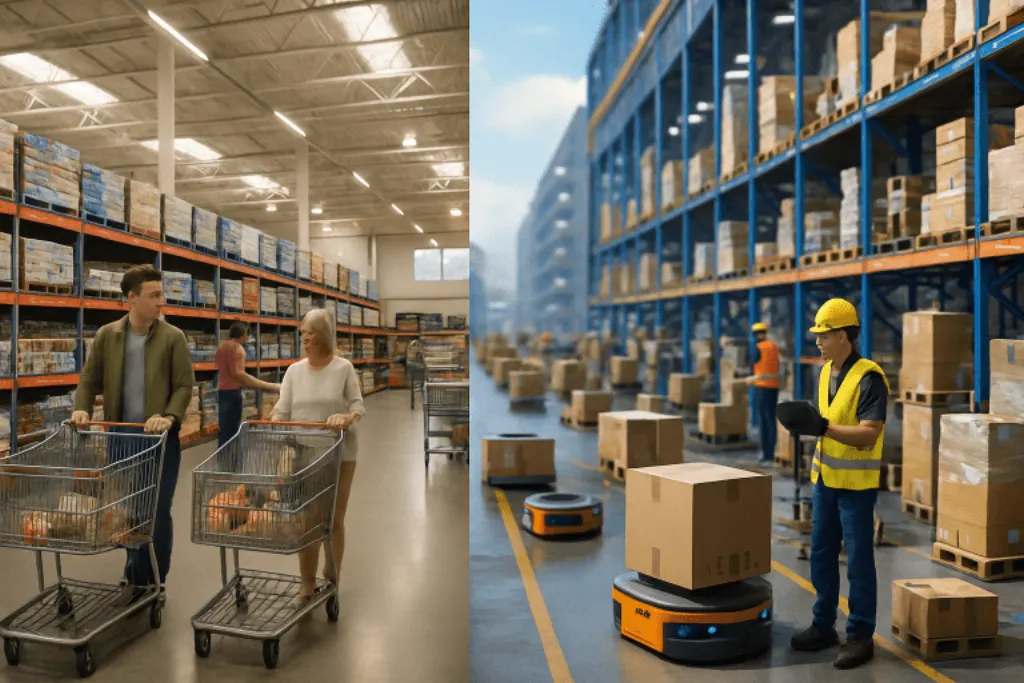
As the retail world rapidly shifts to digital, the two giants of the distribution industry, Costco and Walmart, are taking radically different approaches to this transformation. On the one hand, Costco maintains enviable stability thanks to its proven strategies, while on the other, Walmart is investing heavily to dominate the e-commerce segment. This article explores these contrasting dynamics, offering insights into how these major players are navigating the turbulent waters of online sales and increased competition. From cost structures to digital innovations, each company offers a unique vision of the future of e-commerce, reflecting distinct priorities and perspectives. Costco’s Stability Strategy in a Changing Market Costco has always been known for its unwavering stability in the retail sector. This stability rests on a business model based primarily on membership, which generates recurring and predictable revenue, strengthening the confidence of investors and members (https://econormie.com/business/costco-le-geant-discount-qui-reinvente-le-commerce-en-ligne/). In 2025, Costco continues to refine its membership model, combining it with an increasingly robust online presence. While e-commerce is gaining increasing importance, Costco is not radically deviating from its proven strategy. Instead, it is integrating online sales elements in a measured and strategic manner. Its online sales, although still a fraction of its total revenue, have seen significant growth, registering a notable acceleration last June with an increase of 11.5% (https://alannaandcompany.com/les-ventes-de-costco-grimpent-en-juin-grace-a-une-solide-croissance-de-115-dans-le-commerce-en-ligne/). One of the keys to this stability lies in the prudent management of its product catalogs, as evidenced by its use of its own brand, Kirkland Signature. This allows it to reduce costs while offering a high perceived quality, encouraging members to renew their memberships annually. Furthermore, rather than engaging in an online price war, Costco emphasizes the added value and shopping experience in its warehouses, clearly demonstrated by the logistical efficiency of its model (https://www.ecommercenorthamerica.org/2025/06/25/costco-ecommerce-growth-2025/).
Related reading : Costco is betting big on online sales in the face of Walmart’s growing power.
Related reading : Why is Costco preparing to revolutionize e-commerce and how can you take advantage of…
Ultimately, Costco demonstrates that a targeted and gradual approach to digital can effectively complement a well-established business model. This strategy helps the company confidently navigate a rapidly changing landscape without compromising member satisfaction or brand integrity.
Discover how Costco maintains its stability while Walmart invests heavily in its e-commerce transformation to strengthen its market position.
Its secret lies in its ability to embrace gradual changes where they truly matter, while preserving the uniqueness of its offering through a skillful blend of tradition and innovation. Many analysts see this as a model for companies seeking to succeed in the digital economy without the pitfalls of an overly abrupt transition. Walmart’s Ambitious Investment in E-commerce Unlike Costco, Walmart has chosen to fully embrace the digital revolution with a massive investment in e-commerce.
and digital transformation. With an ambitious goal of growing its online sales by 27% annually, Walmart is pursuing a global transformation strategy that will allow it to compete with e-commerce giants like Amazon (https://onemedia.fr/actualite/lessor-du-e-commerce-chez-walmart-et-costco-menace-t-il-amazon/).

https://www.youtube.com/watch?v=vZNdgStBzoY
Initiative Market Effect Financial Impact
Improved Logistics
Comparison and Contrast of Business Models **Analyzing the paths taken by Costco and Walmart provides a better understanding of the different strategies adopted by retail giants to cope with the rise of e-commerce. By studying these contrasting approaches, we gain a clearer picture of what determines success or failure in a rapidly changing business environment.**Costco, with its emphasis on revenue stability through a membership model, adopts a cautious approach while simultaneously modifying its online channel for increased efficiency. This choice to remain stable while modernizing in a targeted manner ensures continuity for its loyal customers while adapting to digital trends.
Related reading : Walmart’s results review: How the retail giant is catching up to Amazon in e-commerce
In contrast, Walmart, with its massive investments in digital and logistics infrastructure, aims to reinvent the retail landscape. This explicit commitment to innovation and adaptation to modern technologies reflects a willingness to take calculated risks to stimulate growth, even if it means navigating some turbulence (https://alannaandcompany.com/amazon-en-tete-les-sites-de-e-commerce-les-plus-frequentes-en-2025/).
**Here is a comparative table to better illustrate these approaches:**Aspects
Costco Walmart Business Model
Membership
Mixed: physical & digital
Furthermore, the pressure from e-commerce giants like Amazon continues to grow, pushing traditional retailers to redefine their business models to integrate increasingly sophisticated online shopping options. This includes optimizing user experiences, ultra-responsive logistics, and increased personalization of offers (https://alannaandcompany.com/la-chine-renforce-ses-controles-pour-lutter-contre-levasion-fiscale-des-vendeurs-sur-amazon-et-autres-plateformes-e-commerce/).
Discover how Costco maintains its stability while Walmart invests heavily in its e-commerce transformation to dominate the online market. Nevertheless, the challenges are numerous: Reduced margins due to increased digital infrastructure costs.
Adaptation of logistics systems for fast and efficient delivery. Cybersecurity risks and management of customer data integrity. The need to maintain strong customer relationships in an increasingly impersonal world.
These challenges underscore the importance for retail companies to develop integrated strategies that leverage digital technology while preserving the core aspects of their offering and customer experience. Ultimately, success in this new retail landscape will depend on companies’ ability to embrace digital technology not as an end in itself, but as a lever for an enhanced customer experience and optimized service. Future Outlook for Retail As retail continues to evolve, attention is turning to the future and the innovations that could transform the current landscape. Between technological advancements, such as artificial intelligence and blockchain-based management systems, and the rise of more sustainable consumption, numerous new opportunities are emerging for giants like Costco and Walmart.

For Walmart, the future could include expanding its logistics capabilities through warehouse automation and the use of drones for last-minute deliveries. In parallel, strengthening their digital platforms through the implementation of new technologies, such as augmented reality for an immersive shopping experience, could define the future of online retail.
- Here are some possible innovations that could influence the future of the sector:Artificial Intelligence:for increased personalization and better prediction of purchasing trends.
Virtual and Augmented Reality:
for an interactive and engaging shopping experience.
Blockchain:
for product traceability and supply chain transparency.
Drones and Automation:
for logistical efficiency and reduced delivery times.
- These prospects call for continuous reassessment and strategic evolution for Costco and Walmart to remain relevant in an increasingly digital and technologically advanced retail environment. Regardless of the path each company chooses, the real challenge lies in aligning these innovations with rising consumer expectations while ensuring the company’s long-term viability. As we move into 2025, it will be fascinating to see how these retail giants adapt and redefine their business models for this new era.
Read next
 E-commerce news
Costco is betting big on online sales in the face of Walmart’s growing power.
Costco’s Strategic Positioning in the World of E-commerce In 2026, the e-commerce sector continues to grow exponentially
 E-commerce news
Less-Than-Truckload (LTL) Market Growth Projected to USD 110.7 Billion (2025-2029): The Rise of E-Commerce Powers This Expansion, While a Report Examines the Impact of AI on This Transformation.
The global Less-Than-Truckload (LTL) market is poised for significant expansion. Estimated at USD 110.7 billion between
 E-commerce news
Walmart: A decade of transformation under Doug McMillon’s leadership
Digital Transformation: The McMillon Era at Walmart Since Doug McMillon took the helm at Walmart, a significant shift ha
 E-commerce news
E-commerce orders surged 147% last year, but growth remains dominated by the leaders: study
Dramatic Increase in E-commerce Orders in 2025 Last year, the e-commerce sector experienced a real boom. Indeed, e-comme