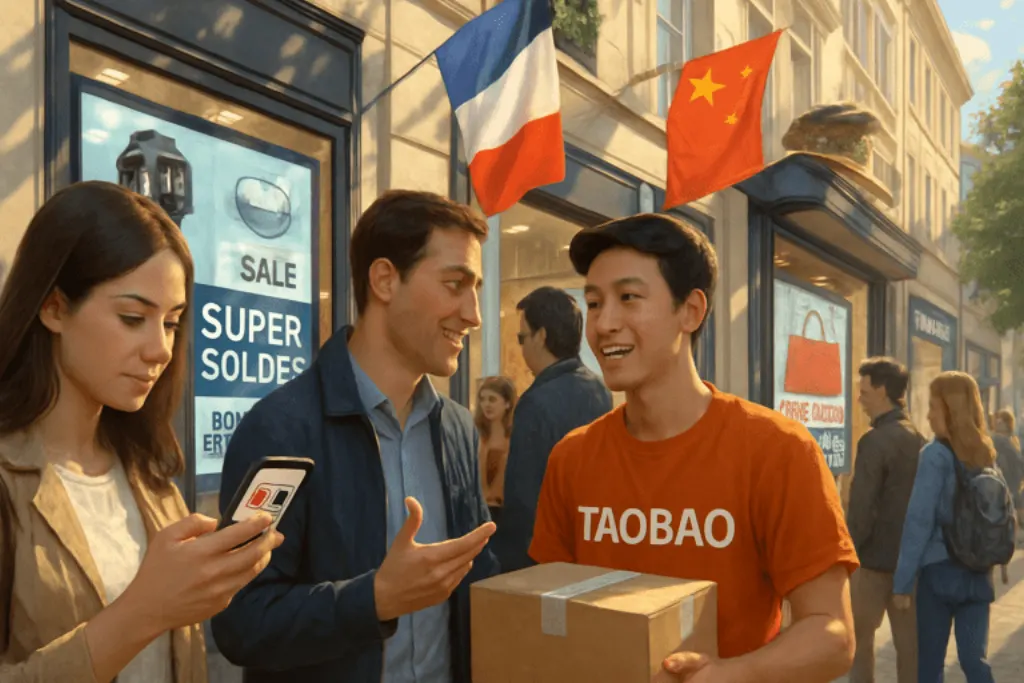
French people are flocking to Chinese e-commerce bargains and are looking for a ‘Taobao agent’ to ensure delivery
Contents4
French consumers are increasingly attracted to Chinese e-commerce platforms, known for their competitive prices and diverse offerings. In this context, the emergence of « Taobao agents » is becoming a significant phenomenon, facilitating access to Chinese products while ensuring reliable delivery. While Taobao, AliExpress, and JD.com are attracting a bargain-hungry audience, broader implications for the local economy and traditional commerce are emerging. In France, there are many challenges and necessary adaptations to address this trend. What are the consequences of this rush toward international online shopping?
The appeal of Chinese platforms: Taobao and its ilk
The rise of Chinese e-commerce platforms such as Taobao, AliExpress, and JD.com is enjoying real success in France. These sites are distinguished by their ability to offer products at extremely competitive prices. For example, users attracted by TikTok videos discover great deals, like Sara Leghtas, a French student who found a handbag for 10 euros on Taobao, adding 25 euros for shipping. **While Taobao is the leading platform, other platforms like AliExpress and JD.com also exploit this niche of low-cost products. These sites appeal to those looking to maximize their purchasing power, compared to more expensive platforms like Fnac or Cdiscount. The selling point is simple: a variety of products ranging from electronics to fashion, often at unbeatable prices thanks to reduced production costs and the enormous scale of the Chinese market.**Discover how the French are taking advantage of the incredible bargains on Chinese e-commerce and why they use ‘Taobao agents’ to guarantee fast and secure delivery of their online purchases.
The table below compares the characteristics of these platforms: Platform Featured Products

Challenges
« Taobao agents » are quickly becoming essential for French consumers seeking to navigate the maze of purchasing on Chinese platforms. These agents facilitate transactions, ensure communication between buyer and seller, and often manage shipping logistics to France.
this practice
developed following the difficulty of overcoming the language and cultural barriers often associated with direct purchases on platforms like Taobao. Agents intervene to overcome these obstacles, also providing a degree of reassurance regarding potential complications related to delivery times or non-compliant products.
Agent services generally include:
Translation and negotiation with sellers in China Coordinating multiple purchases on behalf of a client Logistics management and package tracking
Insurance against loss or damage
- The table below shows how agents compare to direct purchases in terms of services provided:
- Aspect
- With Taobao agent
- Without Taobao agent
Language

Aspects
Chinese e-commerce
French local commerce
Price
Low
Integrated loyalty tools
Targeted promotions via social media
Using data to understand consumer challenges
Discover how the French are taking advantage of the best Chinese e-commerce promotions by leveraging a Taobao agent to guarantee fast and reliable delivery. Don’t miss these great deals!
- These strategies aim to make shopping more attractive and personalized through the lens of omnichannel. Finally, it is crucial for traditional retailers to continue emphasizing their core values, such as quality customer service and product sustainability, in order to emerge as relevant alternatives to Asian players.
- The Future of E-commerce in France
- In 2025, the impact of this shift to online shopping remains strong. Chinese platforms such as Shein and Temu have become major players in the French market, sparking reflections on the future of global commerce. As e-commerce continues to grow, governments and local businesses are being forced to rethink their approaches.
- The European Union, for example, is considering stricter regulations to curb the potential excesses of low-cost shopping and green dumping. The goal is to create a level playing field that promotes fair competition and protects European consumers. At the same time, local commerce is exploring new horizons: eco-responsible initiatives, regional cooperation, and the promotion of local expertise—all approaches that help it stand out.

In conclusion, the future of e-commerce in France lies in continuous adaptation, technological integration, and a collective awareness of complex international challenges. Faced with increasingly fierce competition, players must pivot and invent the next iteration of our consumer experience.
https://viralmag.fr/temu-et-shein-la-menace-chinoise-sur-le-commerce-francais/
Read next
 E-commerce news
Du Simple au Luxueux : Packaging People Dévoile Comment les Boîtes Personnalisées Subliment les Marques E-Commerce
De l’Essentiel au Raffiné : Comprendre l’Évolution du Packaging Personnalisé Dans l’univers du commerce en ligne, où cha
 E-commerce news
In the age of online commerce, entrepreneurs are flocking to local Christmas markets
The Rise of Christmas Markets in a World Dominated by Online Commerce In today’s world, many entrepreneurs are channelin
 E-commerce news
French courts have rejected the government’s request to suspend the e-commerce platform Shein.
The French court’s decision regarding Shein’s suspension request The Paris Judicial Court recently made headlines by iss
 E-commerce news
Retail investors ensure the success of the $604 million IPO of the e-commerce platform Meesho in India
In a rapidly changing global economy, India continues to surprise with the emergence of new digital platforms that are r