OpenAI Instant Checkout: AI and Long-Term E-Commerce, What’s the Difference?
Contents4
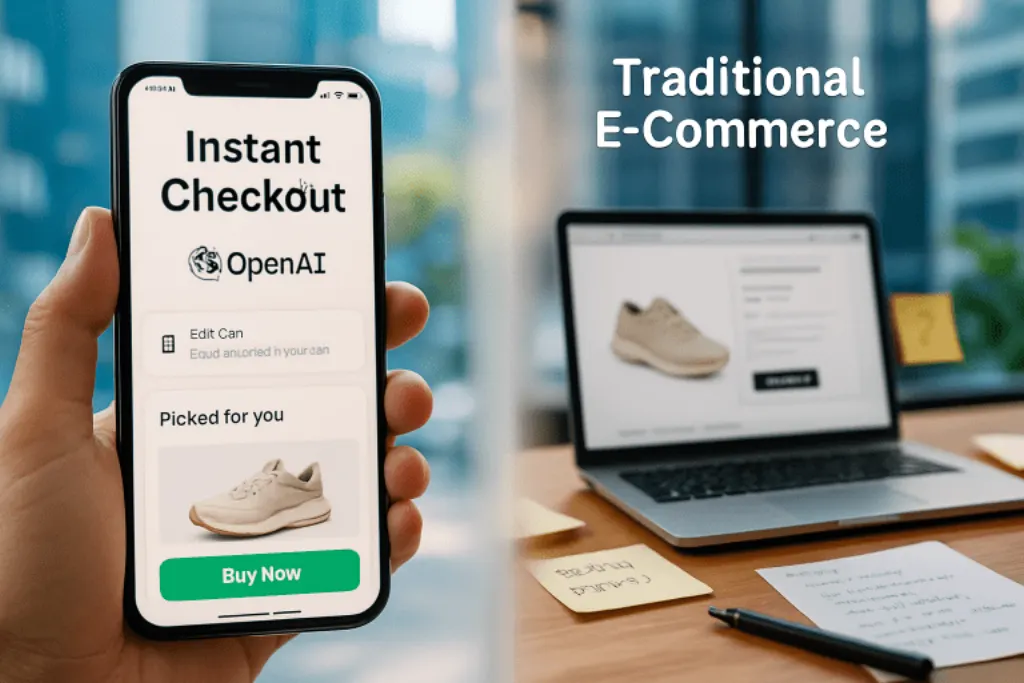
The advent of artificial intelligence is revolutionizing e-commerce by facilitating more sophisticated shopping experiences. OpenAI, known for its ChatGPT technology, recently integrated the « Instant Checkout » feature into its interface, making online purchasing as simple and instant as possible. This innovation signals a radical shift in how consumers approach shopping, reducing the path between product discovery and purchase to a seamless conversation. With partners like Shopify and Stripe, OpenAI is redefining the contours of e-commerce. But what implications does this have for a constantly evolving industry? How does the use of AI differ from long-standing traditional approaches?
Related reading : OpenAI Integrates Etsy and Shopify into ChatGPT’s Cart for an Optimized Shopping…
Related reading : OpenAI’s next revolution: integrating e-commerce into ChatGPT
OpenAI’s Instant Checkout: A Step Toward Instantness
OpenAI recently announced the launch of its new shopping feature, dubbed « Instant Checkout. » Integrated into ChatGPT, this feature allows users to go from product discovery to purchase in just a few clicks, without leaving the conversation. This technological breakthrough was developed in partnership with major players such as Shopify and Stripe, who bring their expertise in online commerce and payments. The world of e-commerce has continued to evolve over the years, with an ever-increasing focus on reducing friction. Instant Checkout transforms a simple conversation into a completed transaction, offering an alternative to existing giants like Amazon and Google. This unprecedented feature boosts conversion by removing barriers often encountered by consumers, such as the need to navigate multiple pages before finalizing a purchase. This simplified user journey encourages more impulse purchases and removes the barriers to conversion that still exist for some e-commerce platforms. Read more about the launch here **.**The benefits of Instant Checkout are complemented by a robust technological foundation. Not only does this feature offer a streamlined checkout experience for consumers, but it also comes with enhanced security measures to ensure every transaction is conducted securely. Thanks to the integration with Stripe, payments are secured with cutting-edge encryption technology. Additionally, the alliance with Shopify allows users to benefit from a proven network that supports thousands of merchants around the world.
While many companies are already trying to simplify the online purchasing process, OpenAI’s ability to combine its natural language processing capabilities with agile payment solutions is driving a new paradigm in the online shopping experience. Learn more.
Discover how OpenAI’s instant checkout is revolutionizing e-commerce compared to long-term solutions. Analyze the key differences between artificial intelligence and traditional approaches to optimize your online sales.
The Impact of AI in E-Commerce Introducing functional AI to the e-commerce industry as OpenAI is doing now represents much more than just a technological evolution; it indicates a profound transformation of the purchasing experience. Unlike traditional methods, where users had to navigate through multiple sites and search filters to find the ideal product, AI now makes it possible to create a personalized and ultra-targeted purchasing journey.The use of artificial intelligence as a shopping companion models a whole series of innovative functionalities:

Related reading : OpenAI Launches Shopping Feature in ChatGPT After Rumors of Major Partnership with Shopify
: AI is capable of analyzing the user’s purchasing preferences, thus making it possible to offer products suited to each person. Imagine receiving only relevant recommendations that meet your needs and personal tastes.
Increased efficiency
: Through the automation of product selection and ordering processes, AI drastically reduces the time spent on research, thereby increasing consumer productivity.
- Trend prediction : Through the analysis of large data sets, AI helps predict future trends and adapt sales strategies accordingly.
- By introducing AI into e-commerce, OpenAI, in partnership with platforms like WooCommerce
- And PrestaShop
, opens a new path where linguistic, cultural barriers and other traditional biases are gradually reduced. The conversational aspect, inherent to the nature of ChatGPT, makes the user experience even more natural and engaging, simulating interaction with a human seller. Additionally, advanced analytics tools from partners like ContentSquare **increase understanding of consumer behavior, providing valuable insights to refine sales strategies.**Read more details on strategic alliances
. https://www.youtube.com/watch?v=zHmOxbnYuZo Comparison with Traditional E-commerce Models While traditional e-commerce business models have long relied on recommendation algorithms and advanced search systems, the integration of OpenAI’s conversational AI is a significant game changer. It stands out by transforming the user experience through a more human and personal interaction.Platforms such as
Related reading : Shopify and Etsy get an unexpected boost from ChatGPT
and
PayPlug
typically handle more linear transactions where the user selects, pays for, and receives a product. In contrast, with OpenAI’s Instant Checkout, the conversational experience is taken to the next level by directly integrating suggestions based on the conversation context, thus fostering intense user engagement. Aspects Traditional E-commerce AI-enabled E-commerce Interactivity Click-limited
Furthermore, while the increased efficiency of sales processes is undeniable, it also raises questions about the future of traditional human customer service. The risk of a massive replacement of professionals by AI specialists cannot be ruled out and requires careful attention from stakeholders. How can collaboration between human and artificial intelligence be encouraged in this context? Data Issues: Collected data must be used transparently and ethically to avoid malicious exploitation.
Trust
: Building and maintaining consumer trust is essential to the widespread adoption of AI in retail. Skills Evolution:
The skills of human resources must be readjusted to meet new market realities.
- Partnerships with advanced management systems such as Mollie
- and logistics solutions such as Lengow
- provide a necessary complement to ensure smooth operations. However, these collaborative efforts must extend to all industry players to truly maximize the benefits. Discover the detailed challenges and opportunities.
Discover how OpenAI’s Instant Checkout integration is revolutionizing e-commerce, comparing its immediate impact with the long-term transformations AI is bringing to the industry. We analyze the key differences to optimize your online store. Future Potential: Towards a Definitive E-commerce Continued advances in e-commerce, fueled by the introduction of intelligent tools like AI, are opening the door to previously unexplored horizons. By 2025, the idea of shopping entirely guided by artificial intelligence that anticipates and responds to your needs instantly could well become the norm. However, the key question is: do these short-term benefits lead to sustainable added value for all market participants? By leveraging new technologies, companies must continually balance responsible innovation with immediate economic imperatives. Many industry researchers and analysts, such as those in the study conducted by Alanna & Company, emphasize the importance of AI in the future of e-commerce but emphasize the need to ensure its effective and ethical use. Explore more analyses here .Continued innovation and improvement in AI technologies promise a wealth of opportunities for companies that embrace them without compromising ethics. The challenge, then, lies in balancing these new revenue-generating capabilities with meeting the evolving needs of modern consumers.

Read next
 E-commerce news
The instant payment system Pix is poised to conquer half of the Brazilian e-commerce market by 2028
Understanding Pix’s Success in the World of Digital Payments The instant payment system Pix, launched by the Central Ban
 E-commerce news
Alibaba strengthens its commitment to instant commerce with a $281 million convenience store project
Chinese e-commerce giant Alibaba Group Holding recently announced an impressive investment of 2 billion yuan (approximat
 E-commerce news
Chinese e-commerce giants ignore regulatory risks to pursue price wars in instant sales
Fierce competition in China's e-commerce sector shows no signs of abating, particularly in the booming "instant sale" sp
 E-commerce news
The US is trying to open the e-commerce door that India has long kept closed
For nearly a decade, the United States has been working to open foreign markets to its e-commerce giants, but has encoun