Revolutionary ! Discover how weak AI is completely transforming our daily lives!

Contents9
Applications of weak AI in our daily lives
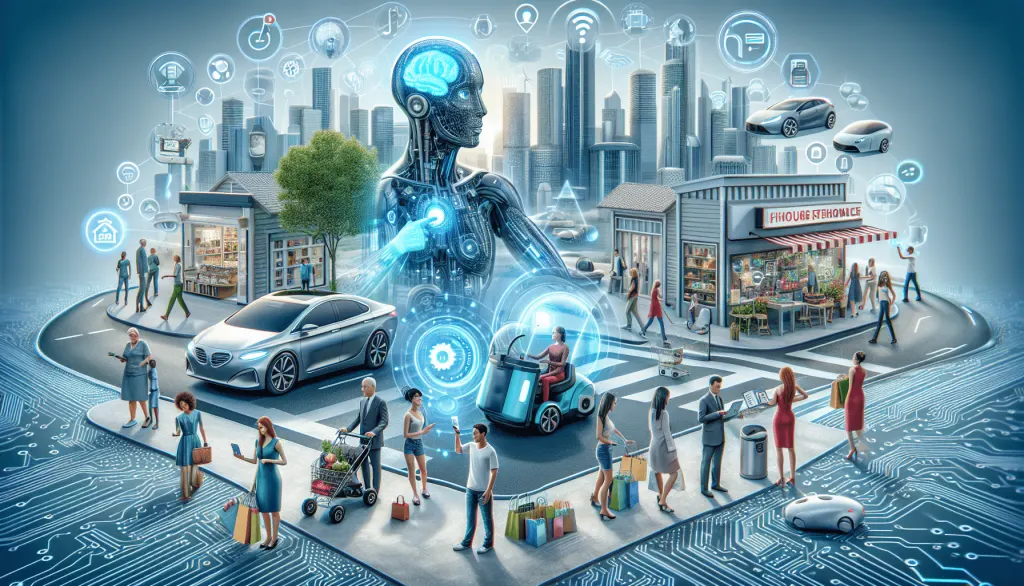
Weak AI, which refers to specialized AI systems designed to perform a specific task, is increasingly present in our daily lives. Here are some of the most common applications of weak AI:
Virtual assistants
Virtual assistants like Siri, Alexa or Google Assistant use machine learning techniques to understand and respond to simple voice commands. They are able to provide information, perform routine tasks and even interact with other smart devices.
Image and voice recognition
Weak AI is used in image and voice recognition. For example, facial recognition is used to unlock our smartphones, and voice recognition is used to transcribe dictations or execute voice commands.
Spam filtering
Spam filters in our email inboxes use machine learning algorithms to analyze email content and identify unwanted messages. This allows us to save time by only processing communications that are truly important.
Recommendation systems
Recommender systems analyze our past behaviors and preferences to suggest movies, products, songs, news articles, etc. These recommendations help us discover new things that suit our tastes.
Medical assistance
Weak AI is used in the medical field to help diagnose diseases and assist doctors in their decision-making. For example, machine learning algorithms can be used to analyze medical images and detect signs of cancers or other conditions.
Autonomous cars
Self-driving cars use sensors and cameras to perceive their surroundings, and machine learning algorithms to make driving decisions. Self-driving cars are able to move and react to driving situations, while minimizing the risk of accidents.
Weak AI has many applications in our daily lives and continues to evolve rapidly. These technologies make our lives easier by automating tasks and providing us with personalized information. It is important to understand and learn how to use these tools ethically and responsibly.
The benefits and limitations of weak AI
Weak AI has several benefits such as improved performance, reduced errors, and time saving. However, it also has limitations such as lack of adaptability, lack of contextual understanding, and dependence on training data.
With weak AI, performance in specific tasks can be significantly improved. Weak AI systems are designed to quickly analyze large amounts of data and make decisions based on pre-established patterns and rules.
Unlike humans, weak AI systems are less prone to human errors. They can perform repetitive tasks with great precision and are not affected by factors such as fatigue, emotions or distractions.
Weak AI helps automate tasks that were previously done manually, saving valuable time. For example, chatbots used in customer service can answer frequently asked customer questions instantly, without the need for human intervention.
However, weak AI systems are designed for specific tasks and are not able to adapt to new situations or solve problems for which they have not been trained. They do not have the ability to understand the context and adapt their behavior accordingly.
Weak AI requires high-quality training data to work properly. If training data is incomplete, biased, or out of date, it may result in inaccurate or discriminatory results.
In conclusion, although weak AI has many advantages such as improved performance, reduced errors and time saving, it also has limitations such as lack of adaptability, lack of contextual understanding and dependency on training data. It is important to consider these advantages and limitations when using weak AI in order to maximize its benefits while avoiding its possible limitations.
Future prospects for weak AI
Weak AI, although less advanced than strong AI, has impressive potential for years to come. It is already used in areas such as transportation, medicine and education, but its applications are still limited and often require human intervention.
In transportation, weak AI plays a critical role in the operation of autonomous vehicles. In the future, it can be expected to play an even greater role in autonomous driving and traffic management.
In medicine, weak AI can be used to analyze large amounts of medical data, provide treatment recommendations, and assist doctors with their diagnoses. It could help detect signs of cancer more quickly and predict epidemics.
In education, educational chatbots powered by weak AI can help students by providing them with answers to questions and personalized advice. They can also help teachers by providing information on student performance and suggestions for teaching.
Although challenges remain, weak AI continues to evolve rapidly and still has many surprises in store.
Read next
 AI news
Discover how automatic reasoning is revolutionizing our daily lives in incredible ways!
The growing role of automatic reasoning Artificial intelligence (AI) is revolutionizing many fields thanks to automatic
 AI news
Shocking revelations about the impact of cognitive learning in our daily lives! Discover the secrets hidden behind this revolution!
What is cognitive learning? Cognitive learning is a process of acquiring and processing information that allows our brai
 AI news
Revolutionary ! Discover how incremental AI will transform your daily life!
What is incremental AI? Artificial intelligence (AI) has seen major advances in recent decades, but a new branch of this
 AI news
Discover how self-adaptive systems will completely change your life!
Self-adaptive systems: definition and operation Self-adaptive systems are computer systems that can adapt and improve wi