Shein under fire: the opening of its Paris store sparks controversy
Contents3
Asian e-commerce giant Shein is currently in the spotlight due to the opening of its first permanent store in France, specifically in Paris. This event, far from being simply a milestone in the company’s international expansion, shines a harsh light on the numerous debates and criticisms surrounding Shein’s controversial practices. While some eager consumers marvel at the diversity of products offered at unbeatable prices, other voices are rising up to denounce the environmental and social impact of the ultra-fast fashion promoted by Shein. Facing well-established rivals like Zara, H&M, and Primark, the opening of this Parisian store is also raising concerns among local players in the ready-to-wear sector.
Shein in Paris: A Controversial Strategic Move
The opening of Shein’s first permanent store in Paris marks a major strategic step for the Chinese company. Known for its dominant online presence, Shein has chosen an iconic location, the Bazar de l’Hôtel de Ville (BHV), for its new store. However, this decision is far from unanimous and is fueling controversy. Local elected officials and retailers are crying foul, worried about the economic repercussions for small French businesses already struggling against international competition. Criticism of Shein is nothing new. The brand has long been accused of aggressive business practices, pushing the concept of « fast fashion » to the extreme. Environmentalists and some politicians denounce the company’s weak environmental standards, adding their voices to a chorus of discontent.
For example, a list of concerns raised by opponents includes:Lack of transparency in working conditions for Shein’s supply chain employees.
The company’s significant carbon footprint due to mass production and globally dispersed logistics.
- The threat to local fashion companies, such as Mango, Kiabi, and Pimkie, which struggle to compete with the low prices offered.
- Brand

The choice of Paris and the BHV department store to inaugurate this new era of physical stores reflects a clear desire to increase Shein’s visibility. However, this move has generated as much fascination as rejection, with each side brandishing its data and arguments for or against Shein’s presence in the heart of the French capital.
The Response of Other Fashion Giants to Shein
The reaction of other fashion brands, such as Zara, H&M, and Primark, to Shein’s opening in Paris is intrinsically linked to their own survival and adaptation strategies in a constantly evolving market. Indeed, these well-established brands in the European market are closely scrutinizing the impact of this new player on their market share.
Companies like C&A and Boohoo, caught in the same fast-fashion storm, are trying to adjust their offerings to remain competitive in the face of Shein’s aggressive pricing and diverse product range. The central question for these brands is how to adapt to an even faster and cheaper business model without compromising their commitments to responsible production.
- Several strategies are being considered:
- Strengthening environmental commitments: Brands like Zara and H&M are increasingly turning to sustainability initiatives to appeal to a clientele that is increasingly concerned about its environmental footprint. Technological innovation: Investing in technology to optimize production, distribution, and inventory management is becoming crucial.
- Focus on customer experience: Making the in-store and online experience more immersive and personalized is key to standing out. Company

The opening of Shein could also prompt other players, such as PrettyLittleThing and Pimkie, to reconsider their approach to the French market. Physical retail, although expensive, can be a response to the expectations of customers who want to touch and try before they buy, illustrating an evolution in purchasing behavior. https://www.ladepeche.fr/2025/11/05/cette-ouverture-va-faire-scandale-surtout-avec-les-ecologistes-la-premiere-boutique-shein-fait-polemique-13032746.phpSource
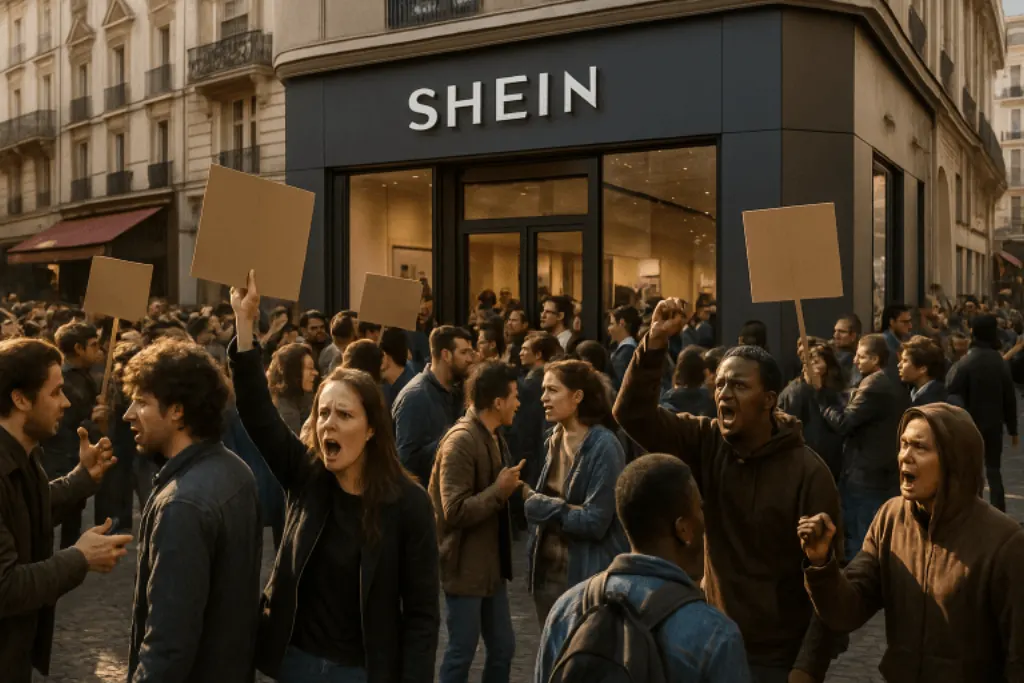
Resurgence of protests and social tensions The red carpet rolled out for the opening of Shein at BHV was not enough to defuse tensions. Indeed, a wave of protests accompanied the event, reflecting the growing discontent of citizens and environmental activists with practices considered harmful.
The protesters wanted to highlight several points:
- Environmental Impact: Overconsumption driven by low prices and short production cycles leads to the overexploitation of resources.
- Working Conditions: Accusations of worker exploitation in partner factories around the world are resurfacing.
- Unfair Competition: Small local businesses denounce the erosion of their customer base to the benefit of global giants.
These social movements highlight a real divide between, on the one hand, a population won over by environmental and ethical discourse and, on the other hand, consumers attracted by the novelty and variety of the products on offer. https://www.boursorama.com/actualite-economique/actualites/shein-sous-le-feu-des-critiques-apres-l-annonce-d-ouvertures-de-magasins-perennes-en-france-4a2ac41e789ab2bc8acf098304c1c104Problem
The Political Implications of Shein’s Opening
In addition to the economic fallout, the opening of Shein in Paris has significant political implications, exacerbating debates over the regulation of the fast fashion sector. Politicians, taking stock of the scale of the demonstrations, express their concerns about the Shein model, deemed incompatible with France’s climate commitments
source .Some proposed measures to regulate Shein’s activity in France include:
Green taxation
- : Impose taxes on imported products whose production does not meet certain ecological standards. Increased transparency
- : Require transparent reporting on the origin of products and manufacturing conditions. Encourage Made in France
- : Support local initiatives and encourage national production through tax assistance. In the political picture, this subject has divided several parties: the debate is intensifying around questions linked to freedom of trade versus social and environmental responsibility. While some politicians want to establish a strict framework around fast fashion, others fear undermining economic freedom, an essential pillar in a globalized market.
Proposal
As Shein strives to solidify its physical presence in France, its future unfolds amidst a storm of ethical and economic criticism. Significant challenges await this fast-fashion giant, which must now navigate turbulent waters where ethics and economics sometimes seem contradictory.
Shein will have to overcome several challenges to ensure its long-term viability:
Adoption of sustainable practices: Integrating more environmentally friendly manufacturing and distribution processes.
- Organizational transparency: Providing more information on internal processes to regain the trust of conscious consumers. Strengthening legal compliance: Adapting to current and future laws, particularly regarding working conditions and environmental impact.
- Discover why the opening of the Shein store in Paris is sparking heated controversy and criticism within the fashion industry. Shein’s future in France largely hinges on its ability to adapt its business model to meet not only consumer needs but also growing expectations for social responsibility. As the company seeks to expand, the world is watching closely how it will respond to these increasing demands. To learn more about the implications of Shein’s opening in France, see this article in the press.
- By balancing growth and sustainability, influence and regulation, Shein exemplifies the modern challenges facing global businesses—a topic that will continue to fuel debate in the future.

Read next
 E-commerce news
Walmart: A decade of transformation under Doug McMillon’s leadership
Digital Transformation: The McMillon Era at Walmart Since Doug McMillon took the helm at Walmart, a significant shift ha
 E-commerce news
Chinese car dealers under pressure from price wars and competition from online sellers
The current price war in the Chinese automotive market has put dealerships in a critical situation. Between reduced marg
 E-commerce news
Consumers are in for a surprise: the imminent removal of the tariff exemption on goods under $800 threatens the world of online commerce
Online commerce has profoundly transformed our consumption habits, allowing consumers to purchase products from around t
 E-commerce news
Chinese e-commerce exports to the US fall 65% under the impact of tariffs
Chinese e-commerce exports to the United States have experienced a dramatic 65% decline due to the significant impact of