Shopify revolutionizes user experience design

Contents9
In the ever-evolving e-commerce landscape, Shopify is dominating the scene with innovations that are redefining UX design. By 2025, this online platform is no longer just a tool for online sellers, but an intuitive, immersive experience that captivates every user. Thanks to the implementation of artificial intelligence and advanced personalization, Shopify promises a decidedly futuristic user interface. While ergonomics are at the heart of this transformation, the customer experience becomes more engaging, transforming each navigation into a seamless and personalized journey. In this article, explore how this major e-commerce player is transforming the user experience, increasing customer loyalty and optimizing the performance of online stores.
Related reading : Shopify’s user experience will soon feel like science fiction
Related reading : Autonomous artificial intelligence is propelling Shopify orders to unprecedented levels…
A User Experience Overhaul Through Innovation
Shopify has always been at the forefront of innovation in the e-commerce sector. With the year 2025, the platform is pushing the boundaries of UX design by introducing technologies that are vividly reminiscent of science fiction scenarios. Imagine an interface that anticipates your needs, adapts its content in real time using artificial intelligence, and provides hyper-personalized recommendations. This is what Shopify is currently doing.
The platform is no longer limited to a simple functional design. It now includes interactive and immersive elements that make navigation not only intuitive but also captivating. These features allow customers to feel not just like buyers, but like active participants within the interface. For example, adaptive interfaces that change based on user preferences offer a truly unique experience for each visitor.
Additionally, Shopify is introducing advanced analytics tools that allow store owners to track every aspect of user behavior in real time. This means every click, every movement, and every interaction can be analyzed to further refine the platform’s usability. A merchant can know precisely where they’re gaining traction and where they need to make adjustments to further captivate their customers.

All of these innovations have a powerful impact on the shopping experience and the conversion of visitors into customers. With these new features, Shopify isn’t just following trends; it’s creating digital trends that are redrawing the contours of UX design. User interfaces on Shopify are becoming dynamic spaces where consumers are naturally drawn to explore further. Simplified and engaging navigation
With the goal of making navigation more seamless, Shopify has implemented features that greatly simplify the user experience. Customers can now access their purchase history at a glance, easily compare products, and benefit from personalized recommendations based on their purchasing behavior.
Product presentation has also been optimized thanks to better categorization and smarter search. The platform’s integrated search engines have been enhanced to deliver more relevant results tailored to user queries. Now, a customer only needs a few seconds to find exactly what they’re looking for among hundreds of available products.
Related reading : Shopify (SHOP): Impressive 29% Annual Growth! Find Out How
Personalization has become a crucial element in developing the user experience. Shopify understands this and now offers powerful tools to adjust every detail of the online store to meet specific user needs. This ability to individually respond to consumer needs is essential for building customer loyalty in the competitive world of e-commerce.
Each merchant has the ability to adapt the appearance and functionality of their store with custom themes and modular extensions. Shopify’s artificial intelligence tools analyze customer preferences and recommend changes to optimize engagement and conversions. For example, a merchant can choose to highlight certain offers to a specific customer segment at opportune times, increasing the chances of conversion.
Discover how Shopify is transforming user experience design with innovative and intuitive tools. Optimize your online store and offer your customers a memorable experience with the latest trends in design and technology.

Customizable themes for each industry
- Targeted product recommendation tools
- Dynamic promotions tailored to user behavior
- Real-time, personalized, welcoming messages
- Customizable customization options based on customer preferences
- Personalization not only improves the user experience; it also opens up opportunities for merchants to cross-channel and combine online sales with physical interaction. As a result, Shopify stores are no longer mere storefronts: they become sophisticated, integrated ecosystems.
Impact on customer loyalty
By offering a personalized experience, Shopify helps build customer loyalty. Customers who feel valued and understood are more likely to return, transforming each purchase into a lasting relationship. Moreover, with the ability to continually adapt offerings to consumers’ evolving needs, personalization becomes a powerful growth driver.
At the heart of this UX revolution by Shopify are the essential digital trends redefining online commerce. More than ever, e-commerce must adapt to changing digital habits, and Shopify is doing so with grace and anticipation.
One of the major trends is the use of artificial intelligence and augmented reality. These immersive technologies allow customers to visualize products in their own environment before even making a purchase. For example, a customer interested in a piece of furniture can see how it fits into their real-life living room thanks to the augmented reality technology integrated into Shopify.
Discover how Shopify is transforming user experience design by offering innovative and intuitive tools to create attractive and engaging online stores. Improve your customer experience and boost your sales with this revolutionary platform.

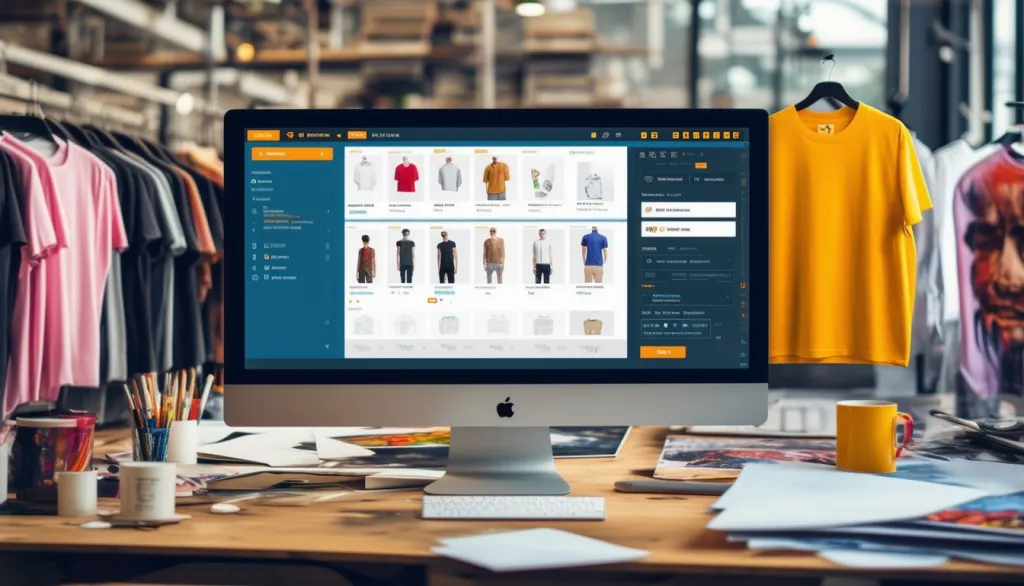
Many Shopify-backed merchants have already begun to take advantage of these advancements. For example, through the integration of Printkk, Shopify is diversifying its print-on-demand capabilities, bringing new innovations to its users.
These trends are accompanied by a crucial need: to secure user data while providing transparency and trust. Data management and privacy practices are constantly being updated to maintain this delicate balance.
The influence of tech startups
Tech startups play a crucial role in this transformation. They are constantly introducing innovations that, when integrated into Shopify, enrich the user experience and push the boundaries of traditional e-commerce practices. E-commerce is becoming not just a sales channel, but a laboratory for continuous innovation and evolution.
Implications for the Usability and Efficiency of Online Stores
Related reading : Shopify ambitionne de devenir l’agence IA intégrée des commerçants
Improving the usability and efficiency of online stores is a priority for Shopify. Advances in usability are reflected not only in the user-friendliness of interfaces, but also in optimizing the performance of online stores.
A well-designed interface leads to less cart abandonment, which is crucial for merchants looking to maximize sales. Regular usability testing allows merchants to quickly identify and correct potential flow issues.
Furthermore, usability is not limited to visual design. These also include page loading speed, clear product descriptions, and simplifying the checkout process. Shopify is committed to continuously improving all of these aspects through regular software updates.
Also, Shopify now offers real-time analytics dashboards that help merchants better understand user behavior. These tools enable rapid decision-making, which is crucial for adapting and improving the customer experience based on feedback.
Appearance
Increase revenue through usability
Effective design will directly impact sales. By optimizing every aspect of usability, online stores on Shopify can not only attract but also retain customers for the long term. Ultimately, the correlation between well-thought-out usability and increased sales is undeniable, making this area of improvement doubly beneficial for merchants.
The Future of User Experience Design with Shopify
In 2025, Shopify isn’t stopping at what’s already been accomplished. In fact, the future of user experience design on the platform promises to be even more transformative. With each update, Shopify’s sophistication and feature richness increase, the platform aims not only to remain at the forefront but to open new avenues in e-commerce.
The potential of artificial intelligence is far from being fully exploited. Virtual shopping assistants that interact vocally with customers and chatbots powered by behavioral data to anticipate user needs are among the innovations currently being developed.
Shopify also aims to expand its customization modules so that no two stores are alike, despite using the same core system. New integrations are planned to enable greater international sales reach while respecting cultural and linguistic differences.
Finally, by strengthening its community of developers and users, Shopify aims to create an ecosystem of exchange where future innovations in UX design will be co-created and shared. This translates into strengthened partnerships with startups and tech giants to evolve and integrate new, cutting-edge solutions. This promising future for Shopify is shaped not only by technology, but also by its vision, which places the quality of the customer experience at the center. The goal isn’t simply to sell more, but to sell better, by making the experience as memorable as possible.
Read next
 Shopify
Shopify’s user experience will soon feel like science fiction
Shopify, evolving at the turn of the year 2025, is redefining the codes of the e-commerce user experience. With a futuri
 Shopify
Essential Window Display Design Principles to Attract More Customers in 2026
In 2026, attracting customers promises to become a true art form. Traditionally, shop windows appealed solely to the gaz
 Shopify
Shopify: User Reviews of the Best Ecommerce Software
# Shopify: User Reviews on the Best E-Commerce Software ## My Story and Success as a Dropshipper I am a Shopify expert a
 Shopify
Shopify revolutionizes print-on-demand with PrintKK integration
IN BRIEF Print-on-demand service Shopify allows connection with various applications on-demand printing for product cust