The US is trying to open the e-commerce door that India has long kept closed

Contents6
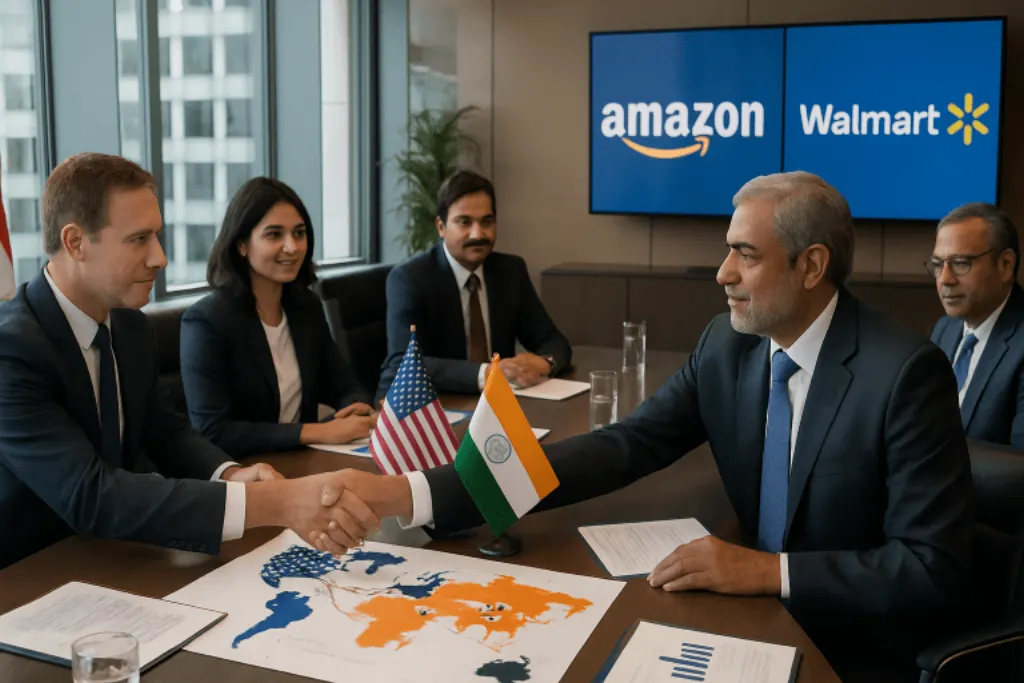
For nearly a decade, the United States has been working to open foreign markets to its e-commerce giants, but has encountered some notable resistance. In 2025, the spotlight is on India, where negotiations to allow American companies to sell their products directly are in full swing. Until now, foreign platforms like Amazon and Walmart have faced strict limitations on inventory management, forcing them to rely on local supplier networks. Washington’s objective is clear: to secure a favorable policy change for e-commerce, an area where competition is fierce between giants such as Alibaba and Reliance Retail.
Related reading : US pushes India to fully open e-commerce access for Amazon and Walmart in trade talks
Related reading : US eyes trade deal with India on e-commerce, crops, data storage
Trade Tensions and Regulations: A Tough Line
The fundamental problem lies in Indian regulations, which differ greatly from those of Western countries. Indeed, India prohibits foreign-backed online retailers from holding and selling their products directly. This policy, introduced to preserve fairness and support small local businesses, represents a major obstacle for players like Amazon and Walmart-owned Flipkart. Conversely, local companies, like Nykaa and BigBasket, are allowed to manage their own inventories, giving them a distinct advantage.
As the debate intensifies, the argument put forward by US negotiators is one of fairness. According to them, an opening would create a level playing field between Indian and foreign companies. Amazon, for example, would be able to source and sell its products directly, thus optimizing delivery times and reducing costs. The stakes are high. India’s digital economy is booming, with an estimated growth potential of $325 billion by 2030, according to a study by Invest India.

Calls for regulatory transparency in digital commerce also reflect a US desire to harmonize practices in the cloud, logistics services, and data processing. But the road ahead promises to be long and winding before consensus is reached between New Delhi and Washington. Furthermore, other areas of tension, such as tariffs, are weighing on bilateral relations, particularly with the recent repercussions of US tariffs imposed on India in response to its purchase of Russian oil.
A Market Under Forced Transformation
As negotiations progress, the shadow of a radical market transformation looms. The evolution of e-commerce in India could indeed stimulate competition and push domestic players to redefine their strategies. Local platforms, until now sheltered from the direct assault of American giants thanks to strict regulations, could be forced to adapt.
- Amazon could finally offer an integrated shopping experience, from acquisition to delivery.
- Flipkart would gain greater access to local and international markets.
- Reliance Retail could intensify its efforts to capture a larger market share.
In this context, opposition groups such as the Confederation of All India Traders (CAIT) are concerned about the implications of such liberalization. The risk of unbalancing the market for small businesses and local retailers is real. Maintaining economic diversity remains a crucial challenge, central to the negotiations.
The impact of policies on e-commerce
The strict enforcement of the open door doctrine by the United States reflects the ambition to ensure an American footprint in international trade. In this dynamic environment, India must skillfully balance its need for economic growth with the protection of national interests.
The implementation of a comprehensive and long-delayed e-commerce policy in India is another major challenge. Despite external pressures, the government is ensuring a well-structured framework around data governance, competition, and consumer protection. This long-delayed policy must be able to incorporate innovations while keeping a vigilant eye on potential abuses. It is in this context of uncertainty that resistance has been amplified by restrictions on foreign direct investment (FDI) and data localization requirements. Current discussions indicate a need for reassessment, especially at a time when e-commerce is playing a vital role in India’s economic growth.
Towards a Global E-Renaissance
Far beyond India’s borders, trade policy movements offer a glimpse of the changes to come within the sector. E-commerce giants’ restrictions on access to large databases, as well as the optimization of inventory models, are substantially influencing the rules of the game.
Discover how the United States is seeking access to the closed e-commerce market in India, a strategic sector protected for years, and the economic and political challenges of this opening.

- profuse renaissance of startups forming the new wave of global e-commerce. Intensified competition with the rise of local platforms challenging leaders like Alibaba and eBay.
- New synergies, with companies like Microsoft and Google entering e-commerce to boost their cloud offerings. In the wake of these trends, discussions between the United States and India are not just a bilateral matter, but a test of the ability of the various players to adapt to a constantly evolving market. The growing pressure of competitive challenges is bound to transform the consumer experience worldwide. Global Economic ImplicationsIndia, with its 881 million internet users, represents immense expansion potential for global e-commerce firms. But the associated challenges and opportunities are not limited to these digital aspects. The bilateral trade relationship between the United States and India is under scrutiny, as it could set precedents for other free trade agreements.
- In light of these upheavals, trade between the two nations continues to grow. During the first months of fiscal year 2026, India’s exports to the United States increased by 18%, while US imports also increased. This underscores the growing intensity of economic relations between the two countries. Discover how the United States is seeking access to the Indian e-commerce market, a sector that the country has strictly protected for years. We analyze the economic issues and the implications for international trade. For the United States, the stakes are also high geopolitically. Indeed, strengthening such partnerships should help counterbalance the influence of China, which has long dominated the global e-commerce scene. Furthermore, ongoing agreements with other major powers such as the United Kingdom and EU members could benefit from a ripple effect. Financial Aspects and Direct Repercussions The issue of market opening carries considerable financial and social stakes. The current trend toward globalization driven by e-commerce is inexorably shifting economic boundaries. Thus, beyond the ongoing negotiations, countries’ economic strategies and policies are being reconfigured. https://www.youtube.com/watch?v=RlOmOXwO1DY
The shift to a
fluid business model
internationally to make international trade more transparent and efficient.
A stronger adaptation to the real-time consumption model, with standardization of practices, as at

and other global leaders.
A major overhaul of pricing systems in response to the demands of a hyper-connected market.
Within this complex chessboard, the convergence between technology and commerce is revolutionizing global interactions. Interfaced local and international connections create diverse economic opportunities, and infrastructure optimization represents a boon for emerging marketplaces.
Read next
 E-commerce news
US pushes India to fully open e-commerce access for Amazon and Walmart in trade talks
In the context of bilateral trade negotiations between the United States and India, the US administration is seeking ful
 E-commerce news
Falling US demand for Shein and Temu after ‘de minimis’ trade loophole closed
Since the closure of the so-called "de minimis" trade loophole, which allowed small packages from China to benefit from
 E-commerce news
Pitney Bowes has just closed its e-commerce hub: Who will really pay the price for this decision?
The recent closure of the Pitney Bowes e-commerce hub is causing serious concern among industry players. This decision,
 E-commerce news
OpenAI Instant Checkout: AI and Long-Term E-Commerce, What’s the Difference?
The advent of artificial intelligence is revolutionizing e-commerce by facilitating more sophisticated shopping experien