UCP: How Shopify and Google Connect AI Agents for Frictionless Commerce
Contents4
Related reading : In-Depth Analysis: Understanding Shopify and Google’s Universal Commerce Protocol by Sam…
UCP: The Automation Revolution with Shopify and Google
As 2026 dawns, a wind of change is blowing through the world of e-commerce. Shopify and Google, industry giants, have joined forces to launch the Universal Commerce Protocol, or UCP, an open standard that is disrupting the way we shop and interact online.
Related reading : Shopify and Walmart adopt Google’s new open commerce protocol
But what exactly is UCP? This innovative protocol, first presented at the National Retail Federation conference, offers an open-source infrastructure to connect AI agents to product discovery, checkout, and after-sales support without requiring custom integrations for each platform. The idea is to create frictionless commerce
where each product is presented as accurately as possible based on the customer’s purchase context, preferences, and browsing history. This initiative didn’t happen overnight. It is the result of extensive collaboration and technological development led by retail giants like Walmart, Target, Etsy, and Wayfair, supported by more than 20 major payment partners such as Adyen, American Express, Mastercard, Stripe, and Visa. Together, they have created a universal language that allows AI agents to navigate the complex world of digital commerce.
One of the most fascinating aspects of UCP is its ability to handle complex transactions. As Harley Finkelstein, president of Shopify, explains, this protocol enables transactions that go beyond simple one-off purchases. It supports subscriptions, managing delivery preferences, and grouping products. For example, if someone buys furniture, they can specify that the delivery not be sent on a Thursday, a day they are not home, but reschedule it for a Friday.
With UCP, interactions between merchants and customers become more seamless, leading to reduced advertising overbilling and a more enriching customer experience. For brands like Gymshark and True Classic Tees, this means increased visibility and unprecedented engagement opportunities with consumers who find their offers tailored to their needs and preferences, rather than influenced by traditional marketing.

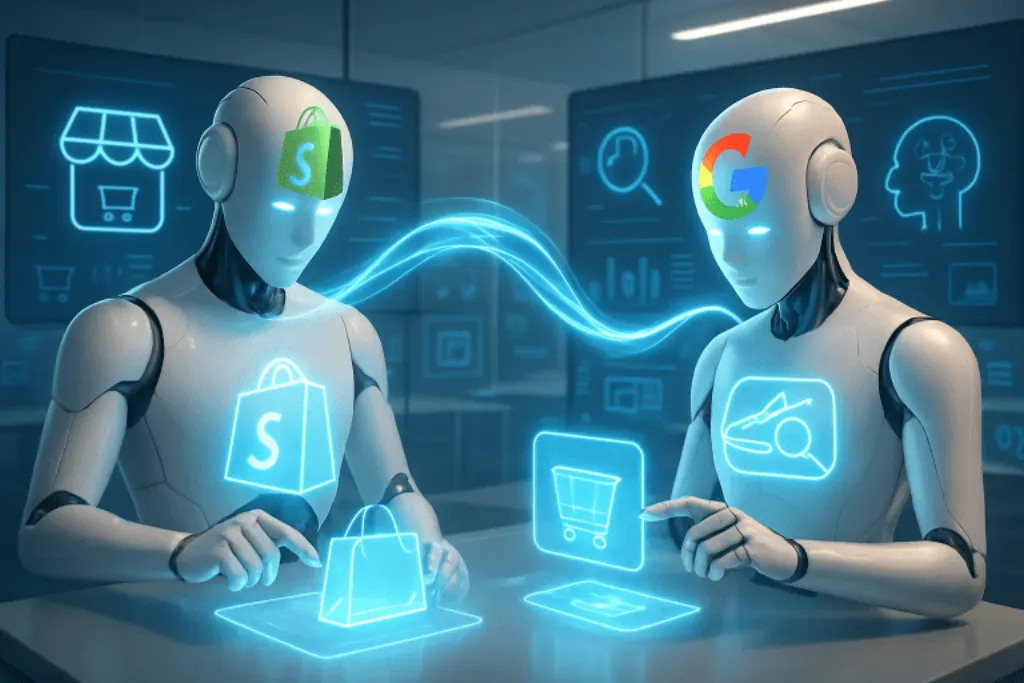
Discover how Shopify and Google are joining forces with AI agents to create a seamless and frictionless shopping experience with UCP.
The Benefits of the UCP Protocol for Merchants The deployment of the Universal Commerce Protocol is transforming the dynamics of e-commerce. For merchants, this technological evolution means leveraging new opportunities for more efficient transactions. First, AI agents, equipped with deep analytics capabilities, can now engage customers in intelligent and personalized ways. **Furthermore, as an open protocol, UCP allows for easy adoption without massive investments in new technological infrastructure. This means that even small businesses can integrate with this system without having to completely migrate their existing sales platforms. Thus, UCP not only revolutionizes how large companies like Target and Walmart operate, but it also makes artificial intelligence innovations accessible to smaller players in the digital landscape.**For the first time, thanks to this unified standard, products can be gathered from a multitude of platforms and presented consistently and relevantly within interactive search results or personalized recommendations. Imagine a consumer searching for a black t-shirt—previously, search engine optimization (SEO) would favor a brand based on its advertising budget. Now, thanks to UCP, the product that appears is selected for its relevance and quality, eliminating marketing budget bias.
Agentic Plan Redeployments like those seen at Google and Microsoft Copilot demonstrate the immense potential of this protocol to integrate product search, discovery, and verification into a single, seamless flow. AI-powered payment facilitation, using tokenized payment systems, adds an extra layer of security to every transaction.
The Impact of AI on E-commerce via UCP
Related reading : Google is strengthening its bet on AI-assisted commerce with a new platform for…
Since the introduction of UCP, the concept of frictionless commerce has moved from a mere ideal to a tangible reality. Merchants are seeing a dramatic increase in visits and orders driven by artificial intelligence. Shopify has even recorded a sevenfold increase in AI-initiated visits and an elevenfold increase in associated orders.
But why is this change so significant? The implications go far beyond simply increasing sales. With UCP, every interaction becomes an opportunity for personalization and enhancing the customer experience. Contextual and historical analytics enrich every touchpoint, transforming AI algorithms into personal concierges. A cosmetics offer could, for example, adapt in real time to a shopper’s previously expressed color preferences. Prediction has evolved; it is no longer simply based on isolated algorithms and their data. UCP powers a chain of integrated actions, ensuring that every discovery, negotiation, and purchase execution is optimized for the consumer’s specific needs. This infrastructure then becomes a support system, where knowledge deepens at every moment, continuously providing new information for service improvement. https://www.youtube.com/watch?v=nboNlCGFKw4The robustness of UCP also lies in its ability to scale. For example, the progressive enhancement of AI agent capabilities opens up limitless possibilities for tomorrow’s customer experiences. When a borrower interacts with multiple agents, their history and preferences are already updated across all partner platforms, ensuring a seamless experience without duplication or lag.
The Technology Behind UCP’s Success
The sophistication of the Universal Commerce Protocol lies in its decentralized and modular structure. Inspired by internet protocols like TCP/IP, UCP breaks down interactions into independent layers: discovery, negotiation, and execution. Each of these steps is efficiently managed through JSON profiles that merchants publish, informing AI agents of specific capabilities and rules, from discounts to delivery preferences.
This innovative approach results in unparalleled flexibility. Integrations extend to REST APIs, the Model Context Protocol (MCP), and many others, ensuring adaptive and secure workflows. Furthermore, open-source plugins available on GitHub, such as the one developed for Shopify, ensure that these benefits extend even to non-native platforms, further reinforcing the protocol’s universality. Google, through its commitment, simplifies things for consumers by centralizing controls within its interface, enabling overall performance monitoring without the need to adjust each platform individually. Vanessa Lee, Shopify’s vice president, emphasizes the protocol’s robustness, noting that it has encapsulated everything they’ve learned over decades to ensure its scalability.
From its initial deployment in the United States, via payment solutions like Google Pay, UCP began transforming the retail landscape, focusing not only on convenience but also on personalization and security, all while guaranteeing a seamless interaction between customers and merchants.
Adopting UCP: Strategies and Challenges
While e-commerce As retailers rapidly adapt to the new dynamics created by User-Created Personal (UCP), they are encouraged to renew their strategies to fully leverage these developments. First and foremost, it is imperative to maintain well-structured product catalogs with detailed capability profiles to ensure that AI agents can operate effectively during discovery and negotiation.
However, UCP adoption presents a challenge, particularly regarding data quality. Merchandising roles will need to evolve from simple product management to detailed and rigorous curation of UCP feeds. This transformation of the retail ecosystem requires technological optimism and a proactive approach to implementing and optimizing AI experiences. Finally, as customer needs and expectations evolve with the increasing prevalence of artificial intelligence, retailers must remain attentive to the rapid changes these technologies enable. Brands will need to innovate, integrate, and transform their approach to retail to thrive in an increasingly data-driven and AI-driven world.
Read next
 Shopify
Shopify mise sur des agents d’IA et des partenaires pour renforcer la fidélité de ses commerçants
L’émergence des agents d’IA dans le commerce électronique Dans le paysage dynamique de 2026, le commerce électronique es
 Shopify
Shopify se prépare à révolutionner le commerce avec l’arrivée des agents d’achat intelligents, selon un cadre dirigeant
Shopify et la Révolution des Agents d’Achat Intelligents Shopify, le géant canadien du commerce électronique, se prépare
 Shopify
Google et Shopify soutiennent l’initiative de Cloudflare pour une surveillance intelligente des bots IA
L’initiative de Cloudflare pour une surveillance intelligente des bots IA Cloudflare a récemment annoncé son engagement
 Shopify
In-Depth Analysis: Understanding Shopify and Google’s Universal Commerce Protocol by Sam Boboev
Google Universal Commerce Protocol: A Revolution foretold In the world of e-commerce, few innovations promise such a rad