Vietnam’s military postal service develops robots to meet the country’s boom in e-commerce
Contents9
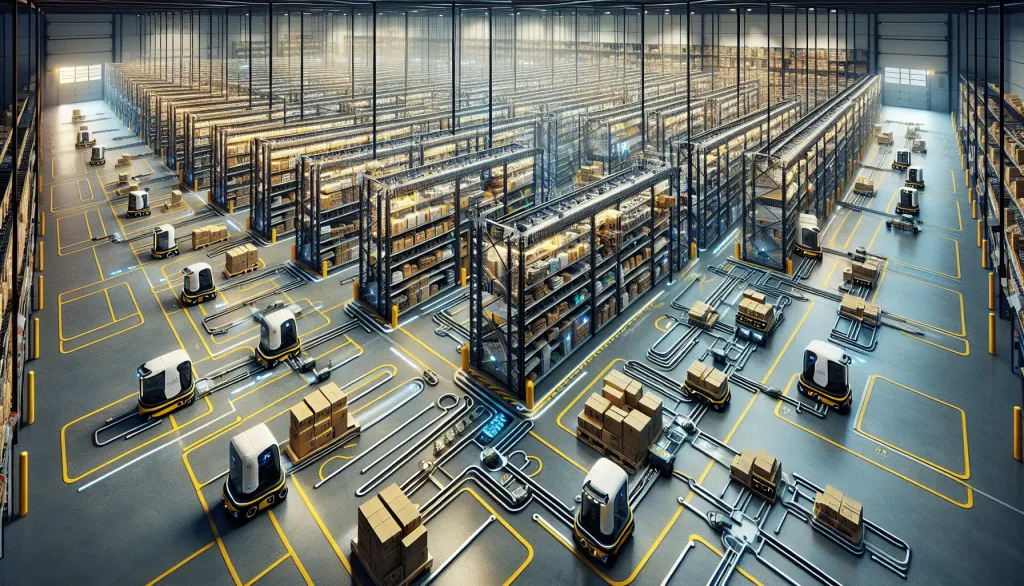
On the eve of Christmas 2024, a warehouse on the outskirts of Hanoi came alive to respond to the excitement of the festive season. Thousands of packages destined for Shopee and TikTok Shop customers were unloaded, sorted, and shipped at a relentless pace using advanced robotic technology. On the floor of this warehouse, the absence of human staff was conspicuous, giving way to approximately 200 beetle-shaped robots that roamed the facility delivering packages with flawless precision.
Gliding at two meters per second, these robots pass under a scanner which reads the QR codes of the packages and guides them to the delivery bags intended for the different provinces. Deployed by Viettel Post, a postal and courier service company owned by Vietnam’s Ministry of Defense, these robots, called automatic guided vehicles (AGV), were first demonstrated in January 2024. Their exceptional performance comes against a backdrop of Vietnam emerging as one of the fastest-growing e-commerce markets in Southeast Asia.
Impact of robotic technology on e-commerce in Vietnam
E-commerce in Vietnam is experiencing unprecedented growth. With players like Viettel Post looking to capitalize on this expansion, the introduction of logistics robots has radically transformed the way they handle shipments. In just one year, the company managed to shorten delivery times by 8 to 10 hours, triple production and increase processing capacity to around four million packages per day, which represents almost 50% of the country’s e-commerce capacity.

Beyond national borders
As a leader in the logistics sector in Vietnam, Viettel Post is now looking for international opportunities, particularly in Cambodia and Burma. The AGV technology they offer is modern and in line with the trends of logistics companies. This is part of Vietnam’s effort to position itself as a regional logistics hub, taking advantage of the rise of its e-commerce.
Vietnam’s logistics sector, worth around $40 billion a year, is growing while logistics costs are high, often doubling those in comparable regions like Singapore. Despite the challenges, the use of robotic technology is an innovative way to optimize the movement of goods nationally and internationally.
Viettel Post and the development of modern logistics robots
THE Vietnamese military postal service has an innate advantage, its vast network, allowing it to deploy efficient automated logistics. A team of talented Vietnamese engineers, winners of national and international robotics competitions, developed the robots used by Viettel Post. After study trips to China, the team had the opportunity to draw inspiration from logistics giants like Alibaba and other automation specialists.
The economic benefits of logistics robots
According to a Viettel Post press release, Yody, a Vietnamese fashion retailer, has managed to cut its labor costs in half after acquiring 48 AGV robots and warehouse management software. For many companies, this breakthrough comes with challenges such as the risk of job losses, new skills requirements, and increased mental pressure on workers.
Future expansion of logistics services in Vietnam
Last December, Viettel Post inaugurated Vietnam’s largest logistics park, covering nearly 144 hectares, with an investment of $130 million. The center, equipped with a standardized database directly connected to Vietnam and China’s customs data, will reduce the time for cross-border product clearance from four to five days to less than 24 hours.
Viettel Post plans to strengthen its cross-border logistics systems with initiatives such as deploying drones for remote areas and installing 1,000 smart lockers to store parcels when recipients are unavailable. One logistics segment that is receiving special attention is fast delivery with robots that helps speed up the delivery process.
The influence of robots and AI in logistics automation
The use of logistics robots in Vietnam is a game changer, highlighting the importance of research and development in robotic technology. By building a robust and innovative logistics infrastructure, Vietnam aims to shift from low-cost manufacturing to high-tech sectors, such as artificial intelligence and semiconductors. The challenges and issues of a changing sector
Vietnam’s logistics sector faces significant challenges due to its fragmentation and inefficiencies. Unlike China’s centralized logistics infrastructure, Vietnam suffers from low consolidation between vendors, e-commerce platforms, and logistics companies. These complications are compounded by the common
cash-on-delivery model, requiring workers to make multiple delivery attempts. Optimization and automation for a better futureTo remain competitive, companies like Viettel Post must develop their
technological capabilities
while preserving their cultural and traditional advantage. The Vietnamese government’s initiatives to digitalize the sector provide a way out of these complex issues, offering new growth prospects for the Vietnam Military Postal Service . https://www.youtube.com/watch?v=53N799KmI2w A look into the future of postal innovationAs the
continues to revolutionize Vietnam’s logistics sector, new economic corridors are opening up, enabling the country to assert itself as a key player in the regional logistics network. Innovations in
robotics and AI promise to transform traditional infrastructure to meet the demands of the global digital economy. https://www.meilleurs-robots.fr/robotique/robot-militaire-futuriste/
Read next
 E-commerce news
Amazon Investit dans les Robots, Satellites et Puces d’IA : Le Seul Titre à Surveiller ?
Amazon et ses Innovations en Robots : Une Nouvelle Ère Technologique Amazon, reconnu pour son avant-gardisme, a récemmen
 E-commerce news
India is considering e-commerce rules imposing « country of origin » filters
At the heart of a digital revolution, the Indian government plans to impose new rules on e-commerce platforms. These reg
 E-commerce news
Indonesia develops new e-commerce tax rules to tackle the underground economy
As Indonesia establishes itself as a major e-commerce player in Southeast Asia, the Indonesian government is firmly focu
 E-commerce news
Meet the Latin American e-commerce platform that’s outperforming Amazon this year
In a constantly evolving market, where Amazon reigns undisputed master in many countries, one e-commerce platform partic