Why Google, Amazon, and OpenAI are clashing in an inevitable AI trade war
The Rise of Tech Giants
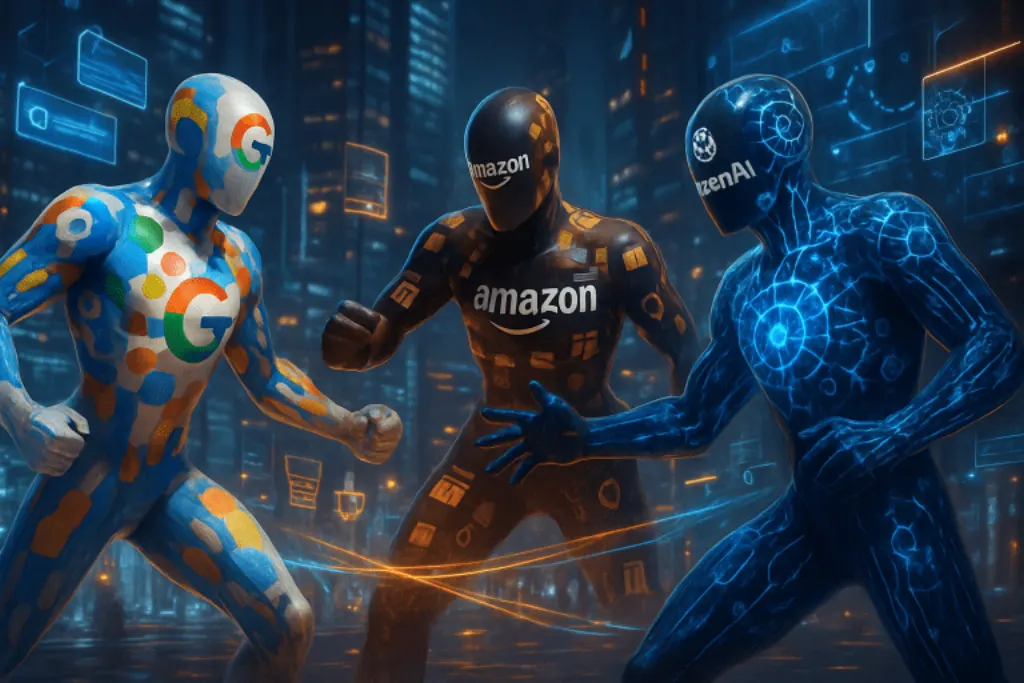
In the world of technology,three names stand out when discussing artificial intelligence and its commercial applications: Google, Amazon, and OpenAI. These companies have invested heavily in the development ofartificial intelligence (AI), seeking to revolutionize various aspects of AI commerce, both online and offline. Google, with its vast data resources and advanced algorithms, has built an ecosystem that integrates AI into products ranging from online search to connected home devices. Amazon is not far behind, having integrated a wide range of AI technologies into its operations, from inventory management to warehouse automation, not to mention Alexa, its voice assistant. Finally, OpenAI, although more recent, has rapidly risen through the ranks by offering advanced AI models, notably with ChatGPT, a conversational AI that could transform customer-business interactions. A striking example of this fierce competition is Amazon’s recent decision to collaborate closely with OpenAI in a massive $38 billion deal. This unprecedented alliance is reshaping the global cloud landscape, demonstrating just how intense and relentless the race to dominate the AI market truly is. This struggle for supremacy isn’t just about acquiring cutting-edge technologies. It also involves controlling critical resources such as artificial intelligence chips and cloud computing infrastructure. Indeed, OpenAI plans to integrate Amazon’s innovative chips, which could not only diversify its infrastructure but also challenge Google’s technological dominance.
The rivalry between these giants is more than just a game of corporate dominance. It has profound implications for how businesses worldwide interact with technology. For example, the increasing use of AI chatbots in e-commerce is redefining consumer expectations for the speed and efficiency of customer service. Ultimately, the rise of these three tech titans is just the beginning of an era where AI commerce is becoming a global battleground. Each seeks to define its own future through continuous innovation and aggressive strategies, demonstrating why this technological war is more inevitable than avoidable. Discover why Google, Amazon, and OpenAI find themselves in an unavoidable confrontation over AI commerce—a major battle shaping the future of technology.
The Stakes of Technological DominationThe fierce competition between Google, Amazon, and OpenAI over AI commerce is fundamentally based on major strategic and economic issues. Having a clear dominance in the field of artificial intelligence can potentially redefine the global market, offering a decisive competitive advantage to influence not only technology but also public and economic policies. Behind the ultimate facade of entertainment and digital assistants, the real battle is being fought on the data front. Access to vast datasets constitutes a virtually inexhaustible resource for feeding AI algorithms and refining their performance. Google, for example, with its dominance in online search, holds an enviable position, leveraging billions of daily queries to constantly improve its machine learning models. Amazon, as an e-commerce behemoth, Google also possesses a goldmine of data on consumer purchasing habits and preferences worldwide.
While not having native access to a comparable volume of data, OpenAI has leveraged strategic collaborations and its groundbreaking products to position itself in the race. This competitive dynamic translates into regularly updated alliances, such as the one with Amazon, which are redefining the landscape of collaboration in this often individualistic tech industry. https://www.2051.fr/actualite/comment-openai-veut-il-concurrencer-google-et-amazon-avec-son-systeme-dachats-integres-dans-chatgpt/ Furthermore, the potential for expansion beyond the traditional boundaries of AI commerce is particularly appealing. Google is showing a strong interest in healthcare and renewable energy solutions, using AI to optimize its practices and anticipate needs. Meanwhile, Amazon is investing in advanced cloud services that make it easier for businesses of all sizes to adopt AI solutions, while OpenAI is targeting a broad audience with its accessible and customizable models, such as ChatGPT, which is integrated into diverse solutions ranging from applications to complex recommendation systems. In this sense, AI is no longer just about technological advancements, but also determines who will orchestrate the economic and cultural future. The increased sophistication of these systems is prompting companies across various sectors to optimize their services while reducing costs. Thus, fierce competition within the AI market is becoming a necessity for these giants, intensifying the ever-evolving technology war.https://www.zdnet.fr/actualites/openai-pret-a-miser-sur-les-puces-damazon-pour-diversifier-son-infrastructure-et-contrer-loffensive-de-google-486791.htmhttps://www.youtube.com/watch?v=CZ0v3f-sQuA
Innovative Strategies and Their Impact The strategies employed by Google, Amazon, and OpenAI in this technological explosion illustrate ingenuity and commercial boldness. Each player is adopting innovative approaches to ensure they don’t fall behind in an ever-accelerating global race. For Google, optimization is the cornerstone. The company seeks to maximize the integration of AI into its existing services while exploring new avenues. For example, its AI platform for e-commerce is constantly being strengthened, enabling retailers to analyze and predict online purchasing behavior. Furthermore, Google is constantly seeking strategic acquisition opportunities to integrate creative talent and advanced technologies, thus securing its market leadership.
Amazon, for its part, is focusing on diversity. The e-commerce giant plans to diversify its AI offerings by creating more seamless environments for developers and businesses. By enhancing the efficiency of its automation algorithms and the power of its cloud services, Amazon remains at the forefront of making AI accessible. A prime example is the development of voice-based services in conjunction with Alexa, which continues to evolve to meet increasingly sophisticated user needs.

For OpenAI, innovation is based on accessibility and experimentation. The company strives to make its AI technologies accessible to a wider audience, seeking to demystify these technological advancements. By partnering with Amazon to offer a
cloud infrastructure OpenAI is a robust player, demonstrating the impact of collaboration in a world dominated by fierce competition. By focusing its efforts on products like ChatGPT, OpenAI enables businesses of all sizes to leverage AI without requiring a heavy investment in personnel or technical resources. It is crucial to note that these strategies are not being deployed in a bubble, but rather in response to a rapidly evolving global technology ecosystem. The speed at which these innovations are integrated into everyday operations often depends on companies’ ability to recognize and react quickly to changing market dynamics. As a result, these diverse approaches are yielding sometimes spectacular returns, altering the global business landscape and prompting other market players to rethink their own strategies. The battle for AI commerce continues to shape the future, with Google, Amazon, and OpenAI determined to lead this revolution.
Implications for the Global Market The effects of the competition between Google, Amazon, and OpenAI extend far beyond their immediate areas of focus, influencing the global market in various ways. The rapid and sustained emergence of AI in business processes has significant implications for businesses, consumers, and governments. For consumers, the integration of AI into everyday transactions has already begun to set new expectations. Whether through enhanced personalized recommendations, more responsive customer service, or even immersive shopping experiences, AI is a key driver of modernization and improving the user experience. This logic applies to various business contexts, from simply purchasing a product online to optimizing complex processes.For businesses, the introduction of AI represents a tremendous opportunity but also a significant challenge. Adopting these technologies can offer a considerable competitive advantage, improving operational efficiency, data analysis, and the customer value proposition. However, it also requires a significant investment in training and adaptation, which is not within the reach of all companies. This partly explains why collaborations like the one between Amazon and OpenAI are crucial for establishing an ecosystem with limited barriers to entry.
The impact of this technological war is also felt at the governmental level. States, aware of the scope of artificial intelligence, are providing regulatory frameworks that assess risks and are leveraging this competitiveness to develop innovation policies to remain attractive to businesses of all sizes. In fact, AI has become a full-fledged diplomatic and economic tool, with each state seeking to align its own technological strategy with that of these giants. Furthermore, this escalating race for innovation raises critical questions about ethics, algorithmic bias, and data security. The rise of these technologies intensifies debates surrounding AI regulation and its influence on the global market, a field where every company strives to demonstrate a proactive approach while remaining focused on the future. https://gemius.fr/openai-intensifie-ses-acquisitions-avec-un-impressionnant-partenariat-de-38-milliards-de-dollars-avec-amazon/https://www.youtube.com/watch?v=DHXwhGw4IvE
An Inevitable Tech WarWhy does this intense competition between Google, Amazon, and OpenAI seem inevitable in the current context of AI commerce?This question finds its answer in the continuous acceleration of technological advancements coupled with irresistible economic dynamics.
First, AI is evolving at an unprecedented pace, forcing companies to innovate continuously to avoid falling behind their competitors’ progress. The need to improve existing systems and develop new products capable of transforming consumer habits has become crucial for a competitive advantage. Moreover, the economic opportunities of AI are simply too great to ignore. This technology offers substantial productivity gains and prospects for expansion into new markets, whether sectoral or geographic. The possibility of conquering a still-expanding market is sufficient motivation for major players to invest considerable resources to maintain the innovator’s edge.
Finally, the balance between ethics and innovation will be central to the debates, with the potential regulation of AI by governments. This aspect adds another layer of complexity to the competition, as each company seeks to influence policy decisions while avoiding bad practices that could tarnish its brand image.
In short, a technological war
An inevitable future is emerging, not only due to relentless innovation but also to the economic dynamism it fosters. A fascinating picture is unfolding where Google, Amazon, and OpenAI continue to compete to shape the future of AI commerce in a world rich with possibilities.
https://initia.ai/i-o-contre-io-la-bataille-continue-entre-google-et-openai/
Read next
 E-commerce news
E-commerce giant Wayfair bets on generative AI by partnering with Google, OpenAI and other industry leaders
Wayfair, the colossus of online commerce, is taking a strategic step by fully embracing the era ofGenerative AI. By ally
 E-commerce news
US pushes India to fully open e-commerce access for Amazon and Walmart in trade talks
In the context of bilateral trade negotiations between the United States and India, the US administration is seeking ful
 E-commerce news
Les ambitions d’OpenAI pour transformer ChatGPT à l’image d’Amazon rencontrent des obstacles
Transformation de ChatGPT en plateforme e-commerce : les ambitions d’OpenAI Dans le paysage dynamique de l’intelligence
 E-commerce news
The AI Revolution in Online Commerce: Impacts on Amazon, Walmart, Meta and Google
As we approach 2025, the face of e-commerce is being profoundly transformed by the increasing integration of artificial