Does ChatGPT’s integration into shopping justify Shopify’s price despite recent market fluctuations?

Contents5
As e-commerce continues to transform at a breakneck pace, the merger between two industry giants, OpenAI with its ChatGPT and Shopify, is shaping up to be a game-changer. In 2025, this alliance raises crucial questions: Will ChatGPT’s integration into the world of shopping really justify the cost of Shopify’s stock, especially in times of market volatility? Recent figures show impressive growth in Shopify’s stock, albeit marked by notable fluctuations. On the one hand, the technological innovations brought by ChatGPT are making the online shopping process more intuitive and customizable than ever. On the other hand, market pressure and investor expectations are making this a decisive year for Shopify. Is the future of digital shopping truly being transformed by AI, and at what cost? Let’s unpack the challenges of this revolution. The Rise of ChatGPT in E-Commerce: A Technological Revolution
The impact of ChatGPT on the world of e-commerce is undeniable. Since OpenAI deployed this technology, ChatGPT has begun to change the way consumers interact with online shopping platforms. Thanks to its ability to understand and respond in natural language, users benefit from a personalized, intuitive, and direct shopping experience. This is a complete game-changer compared to traditional methods where consumers would go through a series of static menus to make their purchases.
OpenAI and Shopify have partnered to integrate ChatGPT directly into the Shopify ecosystem, allowing consumers to ask complex questions and receive accurate answers, while viewing products in the same environment. This integration promises to streamline the purchasing process, limit cart abandonment rates, and accelerate the conversion of visitors to buyers.
(source) https://hubtowork.com/lintegration-discrete-de-shopify-dans-chatgpt-par-openai-une-revolution-pour-la-recherche-shopping-et-le-seo-e-commerce/With ChatGPT’s expanded capabilities, consumers can now search and compare products, receive recommendations based on their previous preferences, or even complete a purchase without ever leaving the chat. This is a significant advantage for Shopify, distinguishing it from competitors such as Amazon, WooCommerce, or BigCommerce. It’s worth noting that this new shopping interface positions ChatGPT as a direct competitor to Google Shopping, which could completely transform the existing e-commerce landscape.
(source) /openai-et-shopify-prets-a-sassocier-avec-lintegration-du-shopping-directement-dans-les-conversations-de-chatgpt/Find out if adding ChatGPT to the Shopify shopping experience is worth the platform’s cost, despite recent market fluctuations. Analysis of the benefits, innovations, and impacts on e-commerce.

Furthermore, by directly integrating merchant catalogs into ChatGPT, this alliance ensures that product availability and pricing remain up-to-date, avoiding issues frequently seen on other e-commerce platforms.
(source) https://innovations.fr/chatgpt-revolutionne-le-shopping-en-ligne/Shopify’s Recent Market Fluctuations: A Worrying Sign?
Shopify’s stock performance in 2025 has captured the attention of many investors with a mixture of excitement and caution. Having posted an impressive 77.1% increase over the past year and 420.6% over three years, Shopify has captivated investors seeking substantial returns. However, this success is not without its challenges. Indeed, after reaching recent highs, the stock has posted a 0.7% decline over 30 days and an 8.5% drop in one week
(source) .This significant volatility is part of a broader context of instability in technology markets, fueled by intense speculation surrounding mergers and acquisitions in the e-commerce sector. OpenAI’s announcement to integrate a payment process into ChatGPT has caused a surge of excitement and nervousness among investors, fueling these fluctuations
(source) .For many financial analysts, these valuation movements call for caution. Although Shopify posted a solid annual gain of 30.4%, the fact that its current valuation exceeds the Discounted Cash Flow (DCF) estimate by 47.2% raises the question of whether its shares are overvalued.
Yet this conservative valuation fails to take into account several aspects of current market dynamics. The growth potential of e-commerce, powered by artificial intelligence, cannot be fully quantified by traditional valuation tools. Furthermore, disruptions in global supply chains or political changes can influence results. Comparison Chart of Technology Stock Prices:
Company
3-Year Change
(source)
It is crucial to understand the value metrics used to evaluate an e-commerce company. Financial experts generally use various criteria: Free Cash Flow:
Currently at $1.80 billion, with projections reaching $5.34 billion by 2029.
- Revenue Growth: Influenced by technological innovation and international expansion. Market Positioning:
- Ability to differentiate against leaders like Amazon and WooCommerce. The real challenge lies in interpreting these figures appropriately. For example, while Shopify’s DCF-based valuation is $95.30 per share, many analysts believe that the expected exponential growth in e-commerce could revalue this figure. The market continues to react not only to the company’s current performance, but also to future expectations, which appear considerable given the focus on AI innovation
- (source) . Cost-Value Comparison Chart:
Indicator Current Value2029 Estimate
Commentary

Offer more accurate recommendations, real-time assistance, and personalized responses.
Inventory Optimization:
Access to optimized sales forecasts and reduction of unnecessary overstock.
- Enhanced Security: Advanced algorithms to detect and prevent fraud. However, fully adopting AI does not come without risks. Companies must invest in the appropriate infrastructure and training. Furthermore, the ethical issues surrounding data use and privacy remain crucial to maintaining consumer trust.
- (source) A relevant case is that of automated recommendations. While these systems have become indispensable elements of sales strategies, they can also turn sour if the algorithms fail to take into account changing preferences or new market trends. Companies must therefore navigate a balance between innovation and vigilance to maximize the benefits of AI.
- (source) Discover how integrating ChatGPT into the online shopping experience can impact Shopify’s perceived value, even in the face of recent market volatility. Analyze whether this innovative feature is truly worth the cost.
Ecommerce Market Outlook in the Age of AI As we move toward a new era of AI-powered online shopping, it’s crucial to consider what the future holds for the e-commerce industry. With the emergence of AI-powered solutions like ChatGPT, competition is intensifying, not only among e-commerce platforms, but also with search giants like Google.This development also offers new growth opportunities for a diverse set of market players:
International Expansions: Companies like Magento and PrestaShop benefit from an improved framework to relaunch their international strategies. Effective payment integrations:Adoption of integrated payment systems with providers like PayPal, Stripe, and innovations in AI platforms.

Hyper-personalized recommendations based on purchase history and user behavior.
The rapid pace of these developments doesn’t mean the immediate disappearance of existing players. On the contrary, those who can embrace these new technologies while ensuring a flawless user experience will likely thrive in this environment.
source
- In partial conclusion, the future of e-commerce is evolving, with endless opportunities for those who invest in innovation and technology. As players like Shopify, OpenAI, and others push the boundaries of digital imagination, consumers and investors eagerly await the next steps in this exciting transformation.
https://www.roboto.fr/blog/chatgpt-shopping-comment-utiliser-la-nouvelle-fonction-d-achat-en-2025
Read next
 Shopify
OpenAI and Shopify ready to partner with ChatGPT’s shopping integration directly into conversations
The collaboration between OpenAI and Shopify promises to redefine the online shopping experience. By integrating a shopp
 Shopify
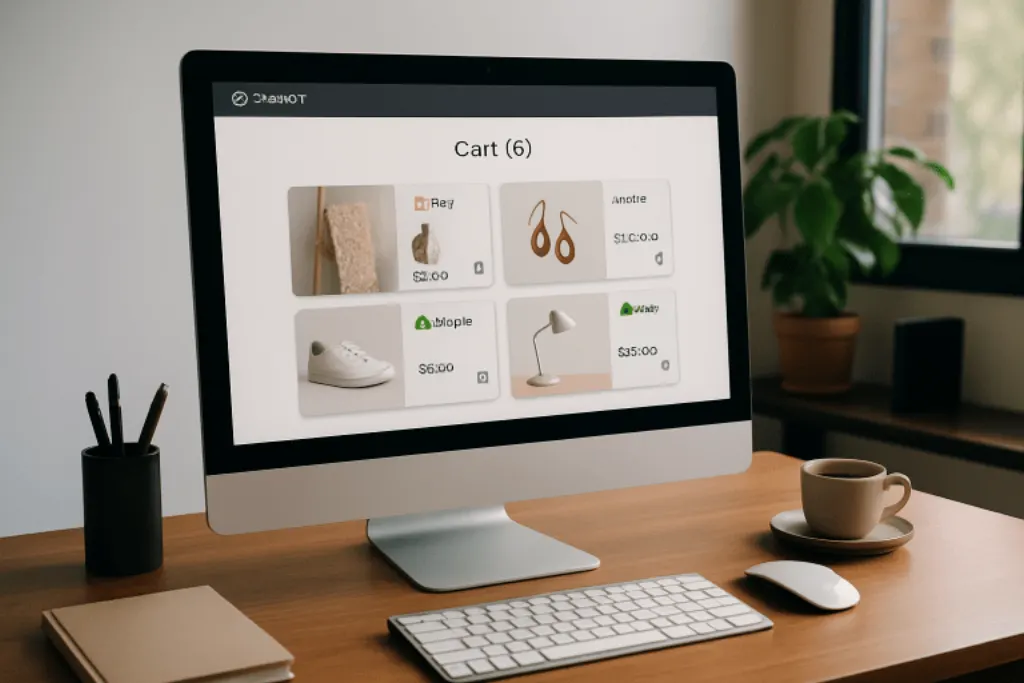
OpenAI Integrates Etsy and Shopify into ChatGPT’s Cart for an Optimized Shopping Experience
In a bold move, OpenAI is changing the e-commerce landscape by integrating Etsy and Shopify into its ChatGPT tool. Thank
 Shopify
Analysis of Shopify’s (SHOP) Valuation After Recent Share Price Weakening and a High Earnings Multiple
Falling Sentiment Doesn’t Stop Shopify’s Gradual Rise The recent market swing, with the notable decline in Shopify (SHOP
 Shopify
OpenAI expands its list of shopping search partners with quiet Shopify integration
In a world where e-commerce continues to evolve, OpenAI is taking a bold step by quietly integrating Shopify into its sh